
tack coat prime coat bitumen
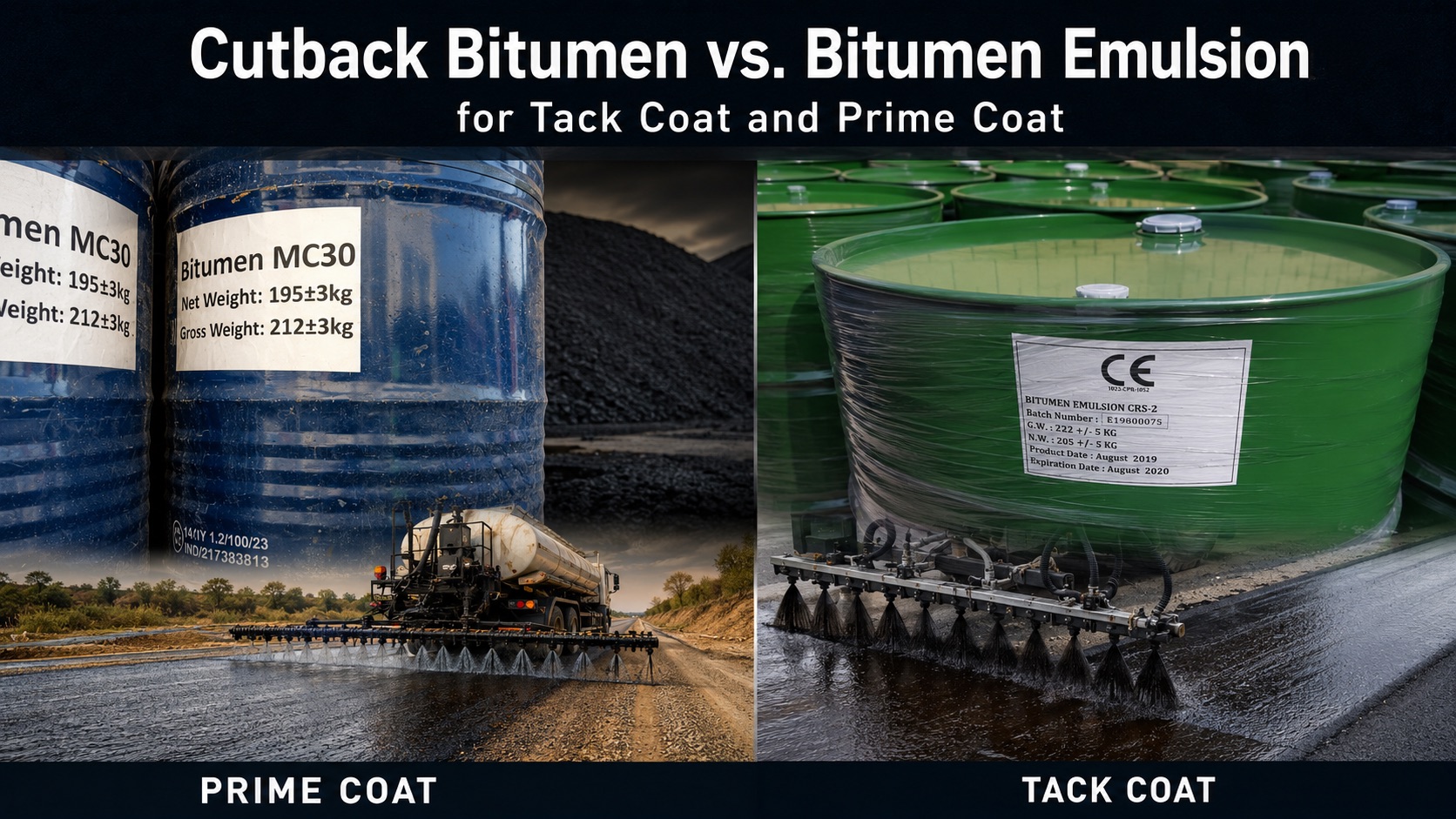
Short answer: Choosing between cutback bitumen and bitumen emulsion for tack coat and prime coat comes down to a handful of practical trade-offs. Cutback bitumen (asphalt cement thinned with a petroleum solvent such as kerosene or naphtha) penetrates deeper and cures more slowly, which historically made it the default choice for prime coat on granular bases. Bitumen emulsion (asphalt droplets dispersed in water with an emulsifier) contains far fewer volatile organic compounds, can be sprayed at much lower temperature, and is now the dominant choice worldwide for tack coat and, increasingly, for prime coat too — with specially engineered “penetrating” or “prime” emulsions closing the gap in base penetration. The right choice depends on the surface being treated, ambient temperature, VOC/air-quality regulation, and how quickly the road needs to reopen.
What Cutback Bitumen and Bitumen Emulsion Actually Are
Before comparing how each performs for tack coat and prime coat, it helps to be precise about what each material is.
Cutback bitumen
Cutback bitumen is produced by blending penetration-grade asphalt cement with a petroleum distillate solvent to temporarily lower its viscosity so it can be sprayed or mixed without excessive heating. Once applied, the material “cures” as the solvent evaporates into the atmosphere, leaving behind the original asphalt binder on and inside the surface it was applied to.
Bitumen emulsion
Bitumen emulsion is manufactured by mechanically shearing hot asphalt into microscopic droplets and dispersing them in water together with an emulsifying agent, forming a stable oil-in-water system. After spraying, the emulsion “breaks”: the water separates from the asphalt droplets, the droplets coalesce into a continuous film, and the water then evaporates, leaving the residual binder bonded to the surface.
How Each One Is Manufactured — The Core Chemical Difference
The dividing line between the two products is what carries the asphalt in liquid form before it sets:
- Cutback bitumen relies on a hydrocarbon solvent (naphtha for rapid-curing RC grades, kerosene-type distillate for medium-curing MC grades, or low-volatility oils for slow-curing SC grades) that must evaporate for the material to gain strength.
- Bitumen emulsion relies on water plus an emulsifier (anionic, cationic, or nonionic surfactant) that keeps the asphalt droplets suspended until they are meant to break, either on contact with an aggregate/base surface (chemical break) or as water evaporates (mechanical/evaporative set).
This single difference in carrier medium is what drives almost every practical distinction covered below: solvent loss versus water evaporation dictates curing speed, VOC emissions, application temperature, storage stability, and how each material behaves on damp versus dry surfaces — all of which show up differently once you get to actual tack coat and prime coat application on a jobsite.
Grades and Classification
Cutback bitumen grades
| Class | Curing speed | Typical solvent | ASTM specification | Common grades |
|---|---|---|---|---|
| RC — Rapid-Curing | Fastest evaporation, high-volatility naphtha-type solvent | Naphtha / gasoline-type | ASTM D2028 | RC-70, RC-250, RC-800, RC-3000 |
| MC — Medium-Curing | Moderate evaporation rate; most widely used for priming | Kerosene-type | ASTM D2027 | MC-30, MC-70, MC-250, MC-800, MC-3000 |
| SC — Slow-Curing | Slowest evaporation, oil-based residual | Low-volatility oil | ASTM D2026 | SC-70, SC-250, SC-800, SC-3000 |
Within each class, the number after the grade name is an approximate kinematic viscosity index — a higher number means a more viscous, slower-penetrating material.
Bitumen emulsion grades
| Setting class | Ionic charge | Typical designation | ASTM specification |
|---|---|---|---|
| RS — Rapid-Setting | Anionic / Cationic (CRS-) | RS-1, RS-2, CRS-1, CRS-2 | ASTM D977 (anionic) / D2397 (cationic) |
| MS — Medium-Setting | Anionic / Cationic (CMS-) | MS-2, CMS-2 | ASTM D977 / D2397 |
| SS — Slow-Setting | Anionic / Cationic (CSS-) | SS-1, SS-1h, CSS-1, CSS-1h | ASTM D977 / D2397 |
| QS — Quick-Setting | Anionic / Cationic (CQS-) | QS-1h, CQS-1h | ASTM D977 / D2397 |
The prefix “C” always marks a cationic emulsion (positively charged asphalt droplets, generally preferred with siliceous or damp/coastal aggregates); the absence of “C” marks an anionic emulsion. Anionic and cationic emulsions must never be blended or stored together. A trailing “h” indicates a harder base asphalt was used, and “P” or “L” indicates polymer or latex modification for higher cohesion and reduced tracking.
Cutback Bitumen vs. Bitumen Emulsion for Tack Coat
A tack coat is a thin, light spray application placed between an existing pavement layer (or milled surface) and a new hot-mix asphalt lift, or between two lifts of new asphalt. Its only job is adhesion — preventing slippage, delamination, and shear failure between layers — so penetration depth matters far less here than it does for prime coat.
- Emulsion is now the default choice for tack coat in virtually every modern specification (FHWA, most U.S. state DOTs, and equivalent international agencies). Slow-setting grades such as CSS-1h and SS-1h — typically diluted 1:1 with water — are the most widely specified materials for standard overlays, while rapid-setting grades such as RS-2 and CRS-2 are used where the road must reopen to traffic quickly.
- Cutback tack coats are still permitted in some specifications but are used far less than in the past. Independent research has found that, compared with correctly applied emulsion tack coats, cutback tack coats can produce lower interlayer bond strength, in addition to the VOC and fire-safety drawbacks discussed below.
- Application rate: tack coat residual application rates typically fall in the range of roughly 0.02–0.10 gallons per square yard (about 0.09–0.45 L/m²), varying by surface type — lower on new/milled asphalt, higher on concrete or heavily oxidized surfaces — with a diluted emulsion applied at roughly double the residual rate.
- Tracking: conventional tack coats remain tacky long enough that construction traffic can pick material up on tires and redeposit it elsewhere (“tracking”). This has driven adoption of polymer-modified, trackless (non-tracking) emulsions engineered to set to a firm, non-sticky film soon after breaking, which cutback products cannot easily replicate without losing penetration.
Grade-by-grade: RC-250 vs. CSS-1h/SS-1h vs. RS-2/CRS-2 for Tack Coat
| Property | RC-250 (legacy cutback) | CSS-1h / SS-1h (standard emulsion) | RS-2 / CRS-2 (rapid-set emulsion) |
|---|---|---|---|
| Current specification status | Rarely specified; phased out in most modern tack coat specs | Most widely specified material for standard overlays | Specified where fast reopening or night work is required |
| Dilution | Sprayed as supplied | Typically diluted 1:1 with water | Typically sprayed undiluted or lightly diluted |
| Residual application rate | ~0.05–0.10 gal/yd² | ~0.03–0.05 gal/yd² residual (0.10–0.15 gal/yd² diluted) | ~0.04–0.08 gal/yd² residual |
| Break / cure time | Slow — solvent evaporation, hours | Moderate — 30–90 minutes at 70°F (CSS-1h) | Fast — 10–30 minutes at 70°F |
| Cold-weather / damp surface suitability | Poor — requires dry surface | Moderate; must not be applied to a frozen surface | Better tolerance for cooler conditions among the emulsion grades |
| Why it’s chosen (or avoided) | Avoided due to VOC, flash point and lower bond strength versus emulsion | Default, well-proven, most economical general-purpose choice | Chosen specifically for schedule-critical or night paving |
Cutback Bitumen vs. Bitumen Emulsion for Prime Coat
A prime coat is applied directly to an untreated or granular base course, before any asphalt layer is placed. Unlike tack coat, its main functions are to penetrate into the base, bind surface fines, provide temporary waterproofing against rain before paving, and promote bond to the first hot-mix layer above it.
- Medium-curing cutback (MC-30 / MC-70) has long been the traditional prime material because it penetrates measurably deeper into dense or fine-grained bases than a conventional emulsion sprayed at the surface. In favorable conditions, MC-30 can penetrate roughly 25–50 mm (1–2 in.) into the base and typically cures in 24–72 hours depending on temperature, humidity and wind.
- Ordinary emulsions sprayed on the surface generally do not penetrate a compacted base adequately on their own — this is a genuine limitation, not marketing language. To overcome it, the industry has developed purpose-engineered “penetrating” or “prime” emulsions (sometimes labelled AEP, EAP, or PCE-type products) formulated specifically to achieve base penetration closer to that of a cutback, without the VOC load. Where ordinary emulsions are used for priming, they typically need to be mechanically worked or mixed into the top of the base rather than simply sprayed, and dilution with water (commonly 1:1 up to about 10:1, water to emulsion) is standard practice to aid penetration.
- Application rate: for cutback prime coats, roughly 0.4–0.5 gallons per square yard (about 1.8–2.3 L/m²) is typical, with the lower figure for smooth, tight bases. Diluted emulsions used for priming are commonly applied at roughly 0.5–1.5 gallons per square yard depending on dilution and base porosity, with looser, more porous sands needing the higher rate.
- Weather sensitivity: emulsions can be applied to a slightly damp base and at lower ambient/material temperature than cutbacks, which generally require a dry surface and higher spraying temperatures to flow and penetrate correctly.
Grade-by-grade: MC-30 vs. MC-70 vs. CSS-1h for Prime Coat
| Property | MC-30 (cutback) | MC-70 (cutback) | CSS-1h (emulsion, diluted 1:1) |
|---|---|---|---|
| ASTM specification | D2027 | D2027 | D2397 |
| Kinematic viscosity at 60°C | 30–60 cSt (most fluid MC grade) | 70–140 cSt (more viscous, for coarser bases) | Not viscosity-graded the same way; behavior set by dilution |
| Approximate penetration into base | ~25–50 mm (1–2 in.) in favorable conditions | Similar to slightly less than MC-30, faster on open-graded bases | Independent lab testing has measured CSS-1h achieving the highest permeability coefficient among tested prime materials — 1.1 × 10⁻³ cm/s versus 4.5 × 10⁻⁵ cm/s for MC-30 — though field penetration behavior still depends heavily on base gradation and density |
| Application rate | ~0.20–0.50 gal/yd² (0.4–0.5 typical) | Similar range, slightly higher for open bases | ~0.15–0.30 gal/yd² residual |
| Application temperature | ~50–70°C (120–160°F) | ~65–80°C (150–175°F) | ~20–70°C (70–160°F) — far lower |
| Cure time before paving | 24–72 hours, weather-dependent | Somewhat faster than MC-30 due to higher asphalt content | Faster water-loss cure in warm, dry weather; slower in cool/humid conditions |
| Best fit | Dense, fine-grained bases where deep penetration is the priority and cutback is not restricted | Coarser or more open-graded bases needing faster cure | VOC-restricted areas, or where a single material is used for both priming and improved base cohesion |
Note: independent field and laboratory results vary by base gradation, compaction, and climate — always validate grade selection against project-specific trial sections before full-scale application.
Side-by-Side Comparison for Tack Coat and Prime Coat
| Property | Cutback Bitumen | Bitumen Emulsion |
|---|---|---|
| Carrier medium | Petroleum solvent (naphtha, kerosene, or oil) | Water + emulsifier |
| Curing / setting mechanism | Solvent evaporation (“curing”) | Emulsion “breaking” then water evaporation |
| Typical application temperature | Higher — commonly 50–80°C (120–175°F) depending on grade | Lower — many grades sprayable near or below 70–85°C, some near ambient |
| Base/aggregate penetration | Generally deeper, especially MC grades on granular base | Shallower unless a purpose-built penetrating/prime grade is used |
| Curing time before traffic/paving | Slower — often 24–72 hours for prime applications | Faster for rapid/quick-set grades; slow-set grades take longer but are common for tack |
| VOC emissions | High — solvent evaporates into the atmosphere | Low — mainly water vapor, with much smaller VOC content |
| Fire / flash-point safety | Lower flash point, greater fire risk in storage and handling | Non-flammable water-based carrier, generally safer to handle |
| Performance on damp surfaces | Requires a dry surface for proper application | Can be applied to a slightly damp base/surface |
| Regulatory status | Increasingly restricted or banned in populated/ozone non-attainment areas | Broadly accepted; the environmentally preferred choice in most current specs |
| Typical modern use | Legacy/rural prime coat applications; still specified in some regions | Default for tack coat; growing share of prime coat via engineered penetrating grades |
Advantages and Disadvantages
Cutback bitumen — advantages
- Deeper, more reliable penetration into dense or fine-grained granular bases, which is exactly what a prime coat needs to do.
- No dilution or mixing-in step needed on most bases — sprays and penetrates as supplied.
- Long, well-documented performance history in prime coat applications across many climates.
Cutback bitumen — disadvantages
- High VOC emissions during curing; increasingly restricted by air-quality and environmental regulations, with use in many U.S. states now limited to unpopulated or rural areas.
- Lower flash point and greater fire risk during storage, transport, and heating.
- Loses the (relatively expensive) solvent fraction to the atmosphere as it cures — an economic as well as an environmental cost.
- Requires a dry surface and generally higher application temperatures than emulsion.
- Slower cure before the next course can be placed, extending project schedules.
Bitumen emulsion — advantages
- Substantially lower VOC emissions — mainly water evaporates, not hydrocarbon solvent.
- Non-flammable water-based carrier: safer for crews and for job sites near occupied areas.
- Can be applied at lower temperature, reducing fuel/energy cost, and can tolerate a slightly damp surface.
- Available in fast-breaking grades that let paving traffic resume sooner — useful where lane closures are costly.
- Trackless/polymer-modified grades solve the tire-tracking problem that plain cutback and conventional emulsion tack coats both share.
Bitumen emulsion — disadvantages
- Standard (non-engineered) grades generally do not penetrate a compacted granular base as effectively as cutback, and may need to be mixed into the surface rather than simply sprayed for priming duty.
- Still contains a meaningful residual VOC fraction, even though it is much lower than cutback — not a zero-VOC product.
- Anionic and cationic emulsions are chemically incompatible and must not be interchanged or mixed on site.
- Breaking/curing behavior is more sensitive to weather (cold, humidity, wind) than is often assumed, and premature breaking in the distributor or on hot surfaces can cause application problems.
- Some slow-setting grades take longer to develop full strength than a comparable cutback under certain conditions, so grade selection still needs engineering judgement.
Environmental, Safety and Regulatory Factors
The shift away from cutback bitumen over the past several decades has been driven primarily by four factors documented in industry literature: environmental regulation of volatile organic compound emissions, the economic loss of high-value solvent to the atmosphere during curing, worker and public safety around a lower-flash-point, more flammable material, and the practical safety benefit of a non-flammable, water-based emulsion. In many jurisdictions, cutback use is now formally restricted to unpopulated or rural roadway sections, while emulsions are required or preferred within and near populated areas. Any export or specification decision should reference the destination country’s current environmental and transport regulations for volatile petroleum products, since restrictions vary significantly by region.
How to Choose the Right Binder for Tack Coat and Prime Coat
| Situation | Recommended direction |
|---|---|
| Priming a dense, fine-grained granular base, no local VOC restriction | MC-30 or MC-70 medium-curing cutback for maximum penetration |
| Priming near populated areas or under VOC/air-quality regulation | Purpose-engineered penetrating/prime emulsion, or an emulsion mixed into the base surface |
| Standard tack coat between HMA lifts | CSS-1h or SS-1h emulsion, diluted 1:1, in almost all modern specifications |
| Tack coat where the lane must reopen quickly / night work | Rapid-setting RS-2 or CRS-2 emulsion |
| High-traffic areas where tire tracking is a problem | Polymer-modified trackless (non-tracking) emulsion |
| Cold-weather or damp-base application | Emulsion generally outperforms cutback, which needs a dry surface |
Final grade selection should always follow the governing project specification (state DOT, national road authority, or client-specified standard) — the guidance above is a starting point for evaluating tack coat and prime coat options, not a substitute for the project’s own spec sheet.
Governing Standards Referenced in This Guide
| Standard | Covers |
|---|---|
| ASTM D2026 | Cutback asphalt, slow-curing type (SC) |
| ASTM D2027 | Cutback asphalt, medium-curing type (MC) |
| ASTM D2028 | Cutback asphalt, rapid-curing type (RC) |
| ASTM D977 | Emulsified asphalt (anionic) |
| ASTM D2397 | Cationic emulsified asphalt |
| ASTM D2995 | Determining application rate of bituminous distributors |
| AASHTO M81 / M82 / M141 | Cutback asphalt specifications (RC, MC, SC) |
| AASHTO M140 / M208 | Emulsified asphalt specifications (anionic / cationic) |
Frequently Asked Questions
What is the difference between cutback bitumen and bitumen emulsion for tack coat and prime coat?
The core difference is the carrier medium: cutback bitumen uses a petroleum solvent that must evaporate to cure, while bitumen emulsion uses water and an emulsifier that breaks and dries. In practice, this makes emulsion the standard choice for tack coat and, increasingly, prime coat too, while cutback is reserved for cases needing maximum base penetration where VOC regulation allows it.
Is cutback bitumen or bitumen emulsion better for tack coat?
For tack coat, bitumen emulsion — particularly CSS-1h or SS-1h grades — is the material specified in almost all current road authority guidance, mainly for VOC, safety, and bond-strength reasons. Cutback tack coats are still permitted in a minority of specifications but are far less common today.
Is cutback bitumen or bitumen emulsion better for prime coat?
Medium-curing cutback (MC-30/MC-70) remains the traditional choice where deep base penetration is the priority and local regulation allows it. Where VOC restrictions apply, a purpose-engineered penetrating/prime emulsion is the modern alternative, though ordinary emulsions generally need to be worked into the base rather than simply sprayed.
Why is cutback bitumen use declining worldwide?
Primarily because of volatile organic compound regulations, the economic loss of solvent during curing, and fire/flash-point safety concerns compared with water-based emulsion.
Can cationic and anionic emulsions be mixed?
No. Cationic (positively charged) and anionic (negatively charged) emulsions are chemically incompatible and must never be blended or stored in the same equipment.
What does the “C” and “h” mean in emulsion grade names like CSS-1h?
The “C” prefix indicates a cationic emulsion; its absence indicates anionic. A trailing “h” indicates the emulsion was formulated with a harder base asphalt for greater cohesion and stiffness.
Do I need to dilute emulsion before spraying?
Slow-setting grades such as SS-1 and CSS-1 are typically diluted about 1:1 with water for uniform tack coat coverage; rapid-setting grades like RS-1 are commonly sprayed undiluted. Dilution ratios for priming vary more widely, roughly 1:1 up to 10:1 depending on base porosity.
References
This guide draws on government road-authority guidance, ASTM/AASHTO standards, and peer-reviewed research rather than competitor or vendor marketing material. Where a figure comes from a single study rather than an established industry consensus, that is noted below.
- Federal Highway Administration (FHWA) — Tack Coat Best Practices TechBrief.
- Federal Highway Administration (FHWA) — Guideline for the Use of Prime and Tack Coats, 2005.
- National Center for Asphalt Technology (NCAT), Auburn University — Report 20-06, Methods for Addressing Tack Tracking: Literature Review.
- ASTM International — D2026, D2027, D2028 (Cutback Asphalt: Slow-, Medium-, and Rapid-Curing Types); D977 (Emulsified Asphalt); D2397 (Cationic Emulsified Asphalt); D2995 (Application Rate of Bituminous Distributors).
- Missouri DOT — Engineering Policy Guide, Category 408: Prime Coat.
- Texas DOT — Asphalt Materials and Uses, Construction Division.
- California DOT (Caltrans) — Tack Coat Guidelines, 2024, and Minimum Tack Coat Spray Rate tables.
- Roadresource.org (Pavement Preservation & Recycling Alliance) — Prime Coat Materials and Specification pages, summarizing FHWA guidance.
- Optimizing prime coat application rates: integrating penetration, permeability, and shear strength, Innovative Infrastructure Solutions (Springer Nature), 2025. Note: the permeability figures comparing MC-30 and CSS-1h cited in this guide come from this single experimental study. They illustrate that emulsion prime coats can outperform cutback on permeability under specific test conditions, but they are not an industry-wide consensus figure — base gradation, compaction, and climate all affect real-world penetration, so project-specific trial sections remain the reliable way to confirm grade selection.
RAHA Bitumen supplies penetration-grade, oxidized, PMB, cutback (RC/MC/SC), and emulsion bitumen to international buyers, with FOB loading from Mersin/Iskenderun and Jebel Ali. See our current bitumen price page for FOB rates by grade, or contact our technical sales team for a grade recommendation matched to your project specification and climate.
