
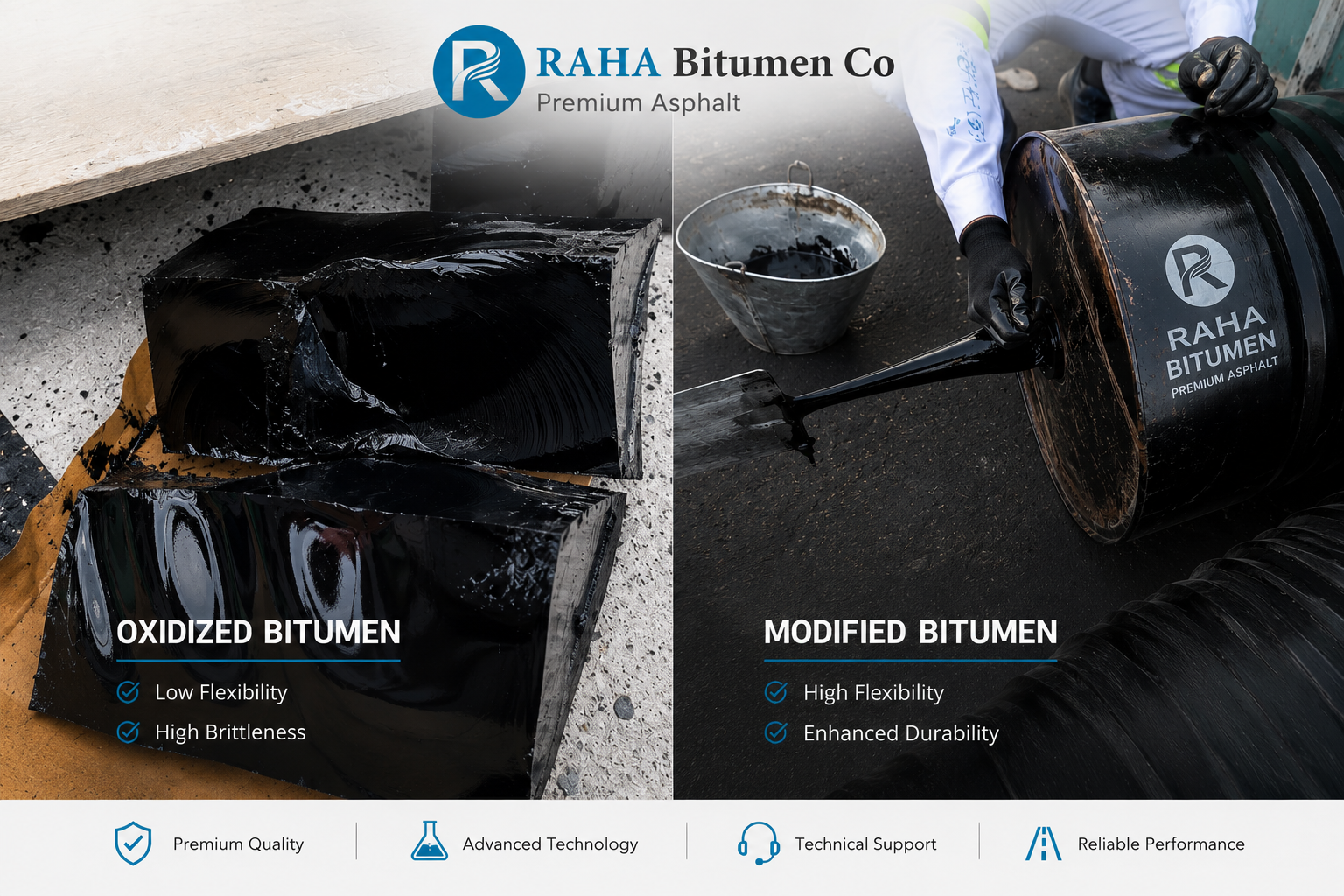
Oxidized Bitumen vs Modified Bitumen: Complete Technical Guide, Key Differences & Which to Choose
Oxidized vs modified bitumen is one of the most consequential decisions in roofing, waterproofing, and infrastructure engineering — yet it is also one of the most frequently misunderstood distinctions in the bitumen industry. Both materials originate from the same petroleum bitumen feedstock, both are used in roofing and waterproofing, and both are sometimes loosely called “special grade” or “treated” bitumen. Yet they are produced by fundamentally different processes, have profoundly different molecular structures, and are optimized for very different performance requirements.
The global polymer modified bitumen (PMB) market grew from USD 11.41 billion in 2024 to USD 12.15 billion in 2025 at 6.5% CAGR, and is projected to reach USD 15.41 billion by 2029 (Research and Markets, 2025). Meanwhile, oxidized bitumen remains the dominant raw material for membrane manufacturing — it is the base material upon which most modified bitumen products are built. Understanding the relationship and differences between these two material types is essential for any engineer, specifier, or buyer working with bituminous materials.
The critical insight: Modified bitumen is not a replacement for oxidized bitumen — it is built from oxidized bitumen. The two materials are complementary, not competing. Oxidized bitumen is the raw material; modified bitumen is the value-added product.
What Is Oxidized Bitumen? Production & Molecular Structure
Oxidized bitumen — also called blown bitumen or blown asphalt — is produced through the controlled air blowing process: penetration grade bitumen is heated to 240–300°C and hot compressed air is injected through it in a reactor. Oxygen from the air reacts with the bitumen molecules through four simultaneous chemical reactions — oxidation, dehydrogenation, condensation polymerization, and cross-linking — fundamentally transforming its molecular structure.
Research published in Applied Sciences (MDPI, 2019) explains the underlying chemistry: the air blowing process causes the bitumen’s colloidal structure to transition from a “sol” type (asphaltenes dispersed in maltene matrix) to a “gel” type (interconnected three-dimensional asphaltene network). This gel structure is what gives oxidized bitumen its characteristic high softening point, low temperature susceptibility, and rigid behavior.
Key measurable changes during air blowing (per Applied Sciences / MDPI, 2019):
- Softening point increases from ~50°C to 85°C–155°C depending on blowing extent
- Penetration decreases from 60–80 dmm to 5–40 dmm
- Penetration Index increases from -1/+1 to +2 to +8
- Asphaltene content increases significantly through condensation reactions
- Temperature susceptibility dramatically reduced
- Volatility reduced — less temperature-sensitive behavior
Grades: 85/25, 90/40, 95/25, 105/35, 115/15, 150/5
Primary standard: ASTM D312 (Types I–IV), BS 3690, EN 13304
What Is Modified Bitumen? Types, Chemistry & Production
Modified bitumen — also called polymer modified bitumen (PMB) — is produced by blending bitumen with polymer additives that enhance specific performance properties beyond what air blowing alone can achieve. Research published in Frontiers in Materials (2023), reviewing bibliometric analysis of global PMB research, confirms that polymer modification fundamentally alters the viscoelastic behavior of bitumen — improving elasticity, fatigue resistance, and temperature performance.
SBS-Modified Bitumen (Elastomeric) — Oxidized vs Modified Bitumen: The Rubber System
Styrene-Butadiene-Styrene (SBS) is a thermoplastic elastomer — a synthetic rubber block copolymer. Research published in Applied Sciences (MDPI, 2019) explains the modification mechanism: when SBS is added to bitumen at 160–185°C, the polystyrene blocks absorb light aromatic components of the bitumen, causing them to swell and forming a co-continuous interpenetrating network of SBS and bitumen phases. This creates a material with dramatically enhanced elasticity and cold-temperature performance — the key advantage of modified bitumen over oxidized vs modified bitumen comparisons in cold-climate applications.
Key findings from peer-reviewed research on SBS modification:
- SBS addition increases softening point, decreases penetration slightly, lessens thermal susceptibility, increases viscosity, and decreases the Frass breaking point (Applied Sciences, MDPI, 2019)
- SBS moderates the increasing of stiffness due to oxidation/aging — maintaining almost unaltered virgin bitumen properties even following RTFOT aging treatments
- Optimal SBS content: 4–7% by weight (higher content can cause phase separation and incompatibility)
- SBS-modified bitumen maintains elongation at break above 47% even under combined thermo-oxidative aging and freeze-thaw cycles (2024 study, cited in Materials and Structures, Springer Nature, 2026)
- UV and oxidative aging resistance: research in Materials and Structures (Springer Nature, 2026) confirmed that SBS molecular weight, vinyl content, and base binder chemistry all significantly affect UV aging resistance — with FTIR oxidation indices rising to 1.53–1.87 after extended PAV aging
SBS market dominance: SBS-modified bitumen accounted for nearly 60% of total PMB market volume in 2024 — approximately 15.4 million tons globally (Market Reports World, 2026), due to its superior elasticity, flexibility, and resistance to rutting and thermal cracking.
APP-Modified Bitumen (Plastomeric) — Oxidized vs Modified Bitumen: The Plastic System
Atactic Polypropylene (APP) is a thermoplastic — a plastic polymer that melts to a liquid at elevated temperatures and resolidifies on cooling. Research confirms that APP is less elastic but stronger than SBS-modified bitumen, with higher resistance to UV radiation, oxidation, and high temperatures. APP has a defined melting point of approximately 149°C (300°F), which makes it unsuitable for hot-mopped application (the bitumen temperature would degrade the APP), but ideal for torch application.
Key APP performance characteristics:
- Softening point: 130–160°C — the highest of the three bitumen types
- UV resistance: superior to both oxidized bitumen and SBS-modified bitumen
- Cold flexibility: brittle below approximately -5°C — inferior to SBS
- Heat resistance: excellent — preferred in hot climates where roof surface temperatures exceed 60–70°C
- Typical APP content: 20–30% by weight of the membrane compound
- Thermoplastic membranes (TPO, PVC) lose thickness through oxidative weathering over time — unlike bitumen membranes which maintain constant thickness (Polyglass, 2025)
The Fundamental Relationship: Oxidized vs Modified Bitumen — Modified Is Made FROM Oxidized
This is the most important — and most commonly misunderstood — aspect of the oxidized vs modified bitumen comparison. The US Patent 9,527,970 (USPTO) explicitly describes this relationship: SBS-modified distillation bitumen with polyethylene wax is developed specifically to achieve properties that are “largely similar or equivalent to those of an oxidized bitumen” — confirming that oxidized bitumen is the performance benchmark that modified systems aim to match or exceed.
Production sequence for APP modified bitumen membrane:
- Start with penetration grade bitumen (60/70 or 80/100)
- Air blow to produce oxidized bitumen 115/15 or 95/25
- Blend hot oxidized bitumen (70–80% of compound) with APP polymer (20–30%) at 170–190°C
- Apply to polyester or fiberglass carrier mat
- Finish with mineral granules or aluminum film
- Finished APP membrane product
This means RAHA Bitumen’s oxidized bitumen — particularly grades 115/15 and 95/25 — is the direct raw material feedstock for APP and SBS modified bitumen membrane manufacturers worldwide.
Complete Technical Property Comparison: Oxidized vs Modified Bitumen
| Property | Oxidized Bitumen | SBS Modified Bitumen | APP Modified Bitumen |
|---|---|---|---|
| Production Method | Air blowing of penetration bitumen | Blending bitumen + 4–7% SBS rubber | Blending bitumen + 20–30% APP plastic |
| Molecular Structure | Gel — cross-linked asphaltene network | Interpenetrating SBS-bitumen co-network | Plastomeric APP matrix |
| Softening Point | 85°C – 155°C | 100°C – 130°C | 130°C – 160°C |
| Cold Flexibility | Brittle below -10°C | ⭐ Down to -28°C (-20°F) | Brittle below -5°C (23°F) |
| Elongation at Break | <5% | ⭐ >600% (virgin); >47% after aging | Moderate — plastic deformation |
| Elastic Recovery | None — permanent deformation | ⭐ Excellent — rubber-like recovery | Poor — permanent deformation |
| Heat Resistance | Excellent (85–155°C) | Good (100–130°C) | ⭐ Excellent (130–160°C) |
| UV Resistance | Poor — degrades under UV | Good — SBS retards oxidative aging | ⭐ Excellent — APP resists UV |
| Aging Resistance | Moderate — aging continues in service | ⭐ Excellent — SBS moderates aging stiffness | Good — APP provides UV barrier |
| Waterproofing | ⭐ Excellent — near-zero permeability | Excellent | Excellent |
| Tensile Strength | Low — brittle material | Good | ⭐ High — strongest of three |
| Material Cost | ⭐ Lowest | Medium-High | High |
| Application Method | Hot-applied (220–230°C) | Torch, cold adhesive, self-adhesive | Torch-applied (APP melts at ~149°C) |
| Fire Risk | High (open kettle) | Low (cold adhesive option) | Medium (torch required) |
| Service Life | 20–30 years | 25–40 years | 25–35 years |
| Primary Standard | ASTM D312, BS 3690, EN 13304 | ASTM D6163, EN 14695 | ASTM D6222, EN 14695 |
The Science of Performance Differences: Oxidized vs Modified Bitumen
1. Cold-Temperature Flexibility — The Most Critical Difference in Oxidized vs Modified Bitumen
This is where oxidized bitumen and SBS modified bitumen diverge most dramatically — and where the science is most clearly established. Research published in NCBI/PMC (2023) on fast-reacting SBS polymer modification confirms that even at SBS concentrations of just 2–3% by weight, bitumen cold-temperature performance improves significantly, with modified materials achieving properties approaching those of conventional 10/40–65 modified bitumen grades.
The mechanism is clear: SBS polymer chains maintain their rubber-elastic behavior at temperatures far below zero, physically preventing the bitumen matrix from becoming brittle. The polystyrene domains (hard blocks) provide structural integrity while the polybutadiene domains (soft blocks) maintain flexibility — a dual-phase architecture that oxidized bitumen’s single-component structure cannot replicate.
Practical implication: In cold climates (below -5°C winter temperatures), oxidized bitumen roofing membranes are prone to thermal shock cracking. SBS-modified membranes maintain flexibility down to -28°C (-20°F) — making them the specification standard for cold-climate roofing and waterproofing in Northern Europe, Canada, Russia, and high-altitude regions worldwide.
2. Elastic Recovery — Why SBS Handles Building Movement
Modern buildings move. Thermal expansion and contraction, structural settlement, wind loading, seismic movement, and substrate deflection all create cyclic stress in membrane systems. Research in Applied Sciences (MDPI, 2019) explains why SBS modified bitumen handles this uniquely: the SBS polymer physically prevents permanent deformation by acting as a resilient spring within the bitumen matrix. Elongation at break exceeds 600% in fresh SBS membranes — and critically, the 2024 study cited in Springer Nature’s Materials and Structures confirmed that elongation at break remains above 47% even after combined thermo-oxidative aging and freeze-thaw cycling — confirming long-term elastic reserve.
Oxidized bitumen has essentially zero elastic recovery — deformation is permanent and cumulative. This makes it unsuitable for structures with significant movement, but entirely adequate for rigid, stable substrates.
3. UV Resistance — Long-Term Durability in Exposed Applications
The landmark 2026 study published in Materials and Structures (Springer Nature) provides the most detailed scientific analysis of SBS-PMB UV aging to date. The research studied 12 different PMB formulations with varying SBS types (linear vs. radial, high vs. low vinyl content) and confirmed that SBS molecular architecture significantly affects UV aging resistance — with FTIR carbonyl and sulfoxide indices rising to 1.53–1.87 after extended PAV aging (40 hours), reflecting the progression of oxidative chemistry even in modified systems.
APP-modified bitumen outperforms both SBS and oxidized bitumen in UV resistance due to the inherent UV stability of the polypropylene polymer — making it the preferred specification for exposed membrane systems without mineral granule protection in high-UV environments (Middle East, Mediterranean, tropical regions).
4. Heat Resistance — Performance in Hot Climates
APP-modified bitumen has a melting point of approximately 149°C (300°F) — significantly higher than SBS systems. Research confirms that APP membranes perform well in sunny, hot conditions where roof surface temperatures regularly exceed 60–70°C. In contrast, SBS can soften and flow if the roof surface temperature approaches its softening point (100–130°C range), making proper specification critical in hot climates.
Oxidized bitumen grade 115/15 (softening point ~115°C) provides heat resistance comparable to many APP systems at dramatically lower cost — making it the cost-effective choice for built-up roofing (BUR) in hot climates where UV exposure is managed by a mineral surface or gravel overlay.
5. Aging Behavior — The Long-Term Performance Difference
One of the most scientifically significant findings in recent PMB research is SBS modification’s effect on the aging process. Research in Applied Sciences (MDPI, 2019) confirmed that “SBS moderates the increasing of stiffness due to the oxidation process simulated by short and long-term aging, maintaining almost unaltered virgin bitumen properties also following RTFOT treatments.” This means SBS-modified bitumen ages more gracefully than oxidized bitumen — maintaining flexibility even as oxidative aging progresses over decades of service.
Frontiers in Materials (2023) bibliometric review of global PMB research also confirmed that SBS modification “significantly improves the physical properties of aged and unaged binder” — with the extent of improvement depending on SBS type, concentration, and base binder chemistry.
Application Guide — Oxidized vs Modified Bitumen: Which Type for Which Project?
Oxidized Bitumen: The Right Choice For
| Application | Why Oxidized Bitumen | Best Grade |
|---|---|---|
| Steel pipe coating (enamel) | High heat resistance, 50+ year track record, AWWA C203/EN 10300 standard | 95/25 |
| Carpet tile backing | Dimensional stability, heat activation in paint ovens, cost | 115/15 |
| Automotive sound dampening | High density, viscoelastic damping, cost-effectiveness at scale | 85/25 |
| Canal & dam lining | Waterproofing, large-area cost, proven hydraulic performance | 90/40 |
| BUR roofing (hot climate, stable substrate) | High softening point, 20–30 year service life, lowest cost | 95/25, 115/15 |
| APP/SBS membrane manufacturing | Primary feedstock — 60–80% of membrane compound by weight | 115/15, 95/25 |
| Below-grade waterproofing | Near-zero permeability, chemical resistance, cost | 85/25, 95/25 |
SBS Modified Bitumen: The Right Choice For
| Application | Why SBS |
|---|---|
| Cold climate roofing (<-5°C winters) | Flexible to -28°C — essential for thermal shock resistance |
| High-movement building structures | Elastic recovery >600% elongation handles structural movement |
| Fire-sensitive installation sites | Cold adhesive and self-adhesive options — no open flame required |
| Premium long-life roofing (25–40 year spec) | Superior aging resistance — maintains flexibility through service life |
| High-performance road surfaces (highways, airports) | 28% higher rut resistance, 35% improved fatigue strength vs standard bitumen |
APP Modified Bitumen: The Right Choice For
| Application | Why APP |
|---|---|
| Hot climate exposed roofing (Middle East, Africa, South Asia) | Highest softening point (130–160°C), excellent heat resistance |
| Exposed membrane — no mineral granule protection | Superior UV resistance — APP provides inherent UV stability |
| Fast-track torch application projects | APP melts cleanly and bonds quickly — faster than SBS |
| High tensile strength requirements | Strongest of the three systems — best puncture and tear resistance |
The Decision Framework: Choosing Between Oxidized vs Modified Bitumen
Step 1 — Is this a roofing/waterproofing application?
No → Oxidized bitumen is standard (pipe coating, carpet tile, automotive, canals)
Yes → Continue to Step 2
Step 2 — What is the winter climate?
Below -5°C → SBS modified bitumen required
Above -5°C → Continue to Step 3
Step 3 — Is the membrane exposed to UV without protective covering?
Yes, in high-UV environment → APP modified bitumen preferred
No (gravel, granules, or coating protection) → Oxidized bitumen or SBS adequate
Step 4 — What is the budget constraint?
Cost-sensitive large area → Oxidized bitumen BUR system
Premium specification → SBS or APP modified membrane
Step 5 — Is there significant structural movement?
Yes (high-rise, seismic zone, large temperature swing) → SBS essential
No (stable, rigid substrate) → Oxidized bitumen adequate
Market Outlook 2025–2030
Both oxidized bitumen and modified bitumen markets are growing, driven by global infrastructure investment and construction activity.
Oxidized bitumen demand: Steady growth driven by industrial applications (pipe coating, carpet tile, automotive, sound dampening), infrastructure expansion in emerging markets, and its continuing role as the essential raw material feedstock for modified membrane manufacturing. The bitumen membrane market overall is growing at 6–8% CAGR through 2030.
Modified bitumen market: The Polymer Modified Bitumen Market size was valued at USD 12.2 billion in 2023 and is projected to grow from USD 12.7 billion in 2024 to USD 17.52 billion by 2032, growing at a CAGR of 4.10%.
SBS dominance: SBS-modified bitumen accounted for nearly 60% of the total market volume, or about 15.4 million tons, due to its superior elasticity, flexibility, and ability to resist rutting and thermal cracking, especially in high-traffic and temperature-variable regions.
Key growth driver: More than 62% of road development agencies now adopt polymer-modified formulas due to 28% higher rut resistance and 35% improved fatigue strength.
Why Source Both Types from RAHA Bitumen?
RAHA Bitumen (RABIT) supplies both oxidized bitumen grades and polymer modified bitumen to customers in over 100 countries — covering the full spectrum of bituminous materials needed for roofing, waterproofing, road construction, and industrial applications.
- Full oxidized bitumen range: 75/25, 85/25, 85/40, 90/40, 95/25, 105/35, 115/15, 150/5 — the raw material backbone for membrane manufacturing and industrial applications
- Consistent quality: SGS and Bureau Veritas third-party verified for every shipment
- Complete documentation: TDS, MSDS, COA for all grades
- Multiple packaging: Bulk tanker, 200L drums, 25kg meltable polyamide bags, kraft bags
- Fast global delivery from Dubai, UAE logistics hub
- Technical support: Grade selection and application guidance from our engineering team
📞 Contact our technical team:
Dubai Office: +971 56 281 7292 (WhatsApp)
Email: info@rahabitumen.com
Frequently Asked Questions — Oxidized vs Modified Bitumen
What is the main difference between oxidized bitumen and modified bitumen?
Oxidized bitumen is produced by air blowing penetration bitumen at 240–300°C — no polymer additions. It creates a hard, heat-resistant, waterproof material through chemical cross-linking of asphaltene molecules. Modified bitumen adds polymers (SBS rubber or APP plastic) to a bitumen base, enhancing flexibility, UV resistance, and cold-temperature performance at higher cost. Research in Applied Sciences (MDPI, 2019) confirms that SBS modification creates an interpenetrating polymer-bitumen network that fundamentally changes viscoelastic behavior — giving the material rubber-like properties that oxidized bitumen cannot achieve.
Is modified bitumen always better than oxidized bitumen?
No — neither is universally better. For pipe coating, carpet tile, sound dampening, large-area waterproofing, and hot-climate BUR roofing, oxidized bitumen delivers excellent performance at the lowest cost. SBS modified bitumen is superior for cold climates, high-movement structures, and long-service-life roofing. APP modified bitumen is superior for exposed membranes in high-UV environments. The right choice in any oxidized vs modified bitumen decision depends entirely on the application, climate, performance requirements, and budget.
Is APP modified bitumen made from oxidized bitumen?
Yes. APP modified bitumen membranes use oxidized bitumen — typically grade 115/15 or 95/25 — as their primary raw material, comprising 70–80% of the membrane compound by weight. The APP polymer (20–30%) is blended into the hot oxidized bitumen. US Patent 9,527,970 explicitly confirms this relationship: SBS-modified distillation bitumen is developed to achieve “properties largely similar or equivalent to those of oxidized bitumen” — confirming oxidized bitumen as the performance benchmark.
What is the cold-temperature performance difference between oxidized and SBS modified bitumen?
Oxidized bitumen becomes brittle below approximately -10°C — thermal shock can cause cracking. SBS modified bitumen maintains flexibility down to -28°C (-20°F). Research published in NCBI/PMC (2023) confirms that even low SBS concentrations (2–3% by weight) significantly improve cold-temperature performance. The 2024 study cited in Springer Nature’s Materials and Structures (2026) confirmed elongation at break remains above 47% even after combined thermo-oxidative aging and freeze-thaw cycling in SBS membranes.
How does SBS modification affect bitumen aging?
Research in Applied Sciences (MDPI, 2019) confirmed that SBS modification significantly moderates aging-induced stiffening: “SBS moderates the increasing of stiffness due to the oxidation process simulated by short and long-term aging, maintaining almost unaltered virgin bitumen properties also following RTFOT treatments.” The Frontiers in Materials (2023) bibliometric review further confirmed that SBS “significantly improves the physical properties of aged and unaged binder” — meaning SBS-modified bitumen maintains more consistent performance throughout its service life compared to oxidized bitumen.
Can oxidized bitumen be converted to modified bitumen on-site?
No. The polymer modification process requires controlled high-speed mixing of molten bitumen and polymer at precise temperatures (typically 160–185°C) for extended periods (2–4 hours) to achieve homogeneous polymer dispersion. This requires industrial mixing equipment. On-site blending of SBS or APP into oxidized bitumen without proper equipment produces inhomogeneous material with poor performance. Always purchase factory-produced modified bitumen from qualified manufacturers.
Key Academic & Technical References
- Yildirim, Y. (2007). Polymer modified asphalt binders. Construction and Building Materials, 21(1), 66–72. DOI: 10.1016/j.conbuildmat.2005.07.007
- Fini, E. et al. (2019). Bitumen and Bitumen Modification: A Review on Latest Advances. Applied Sciences, MDPI, 9(4), 742. DOI: 10.3390/app9040742
- Frontiers in Materials (2023). A bibliometric analysis and review on the performance of polymer-modified bitumen. DOI: 10.3389/fmats.2023.1225830
- Materials and Structures, Springer Nature (2026). Resistance of polymer modified bitumen to UV radiation and oxidative aging depending on SBS characteristics and base binder chemical composition. Springer Nature Link
- NCBI/PMC (2023). Evaluation of Bitumen Modification Using a Fast-Reacting SBS Polymer at a Low Modifier Percentage. PMC10142492
- US Patent 9,527,970. Polymer-modified bitumen compound for a bituminous covering layer of a roof sheet. USPTO.
- ASTM D312/D312M. Standard Specification for Asphalt Used in Roofing. ASTM International. ASTM.org
- ASTM D6163. Standard Specification for SBS Modified Bituminous Sheet Materials. ASTM International.
- ASTM D6222. Standard Specification for APP Modified Bituminous Sheet Materials. ASTM International.
- Research and Markets (2025). Polymer Modified Bitumen Market — Global Forecast to 2029.
- Polyglass USA (2025). Excellence in Roofing: Look to Modified Bitumen Membranes.
Summary – Oxidized vs Modified Bitumen at a Glance
| Parameter | Oxidized Bitumen | SBS Modified | APP Modified |
| Base Material | Penetration bitumen (air blown) | Oxidized bitumen + 4–7% SBS rubber | Oxidized bitumen + 20–30% APP plastic |
| Cold Flexibility | Brittle below -10°C | ⭐ To -28°C | Brittle below -5°C |
| Heat Resistance | Excellent (85–155°C) | Good (100–130°C) | ⭐ Excellent (130–160°C) |
| UV Resistance | Poor | Good | ⭐ Excellent |
| Elongation at Break | <5% | ⭐ >600% (virgin) | Moderate |
| Cost | ⭐ Lowest | High | High |
| Service Life | 20–30 years | 25–40 years | 25–35 years |
| Primary Use | Industrial, pipe coating, carpet tile, BUR roofing, membrane feedstock | Cold climate roofing, high-movement structures, roads | Hot climate exposed roofing, UV-resistant membranes |
Related Products & Pages:
→ All Oxidized Bitumen Grades
→ Oxidized Bitumen 115/15 — primary APP membrane feedstock
→ Oxidized Bitumen 95/25 — SBS/APP membrane feedstock
→ Oxidized Bitumen vs Penetration Bitumen
→ Oxidized Bitumen for Roofing
→ Oxidized Bitumen for Waterproofing
→ Blown Asphalt Production Process
→ Oxidized Bitumen for Pipe Coating
Page last updated: June 2025 | Published by RAHA Bitumen Co. (RABIT) | Dubai, UAE
