
Bitumen 60/70 vs Bitumen 80/100
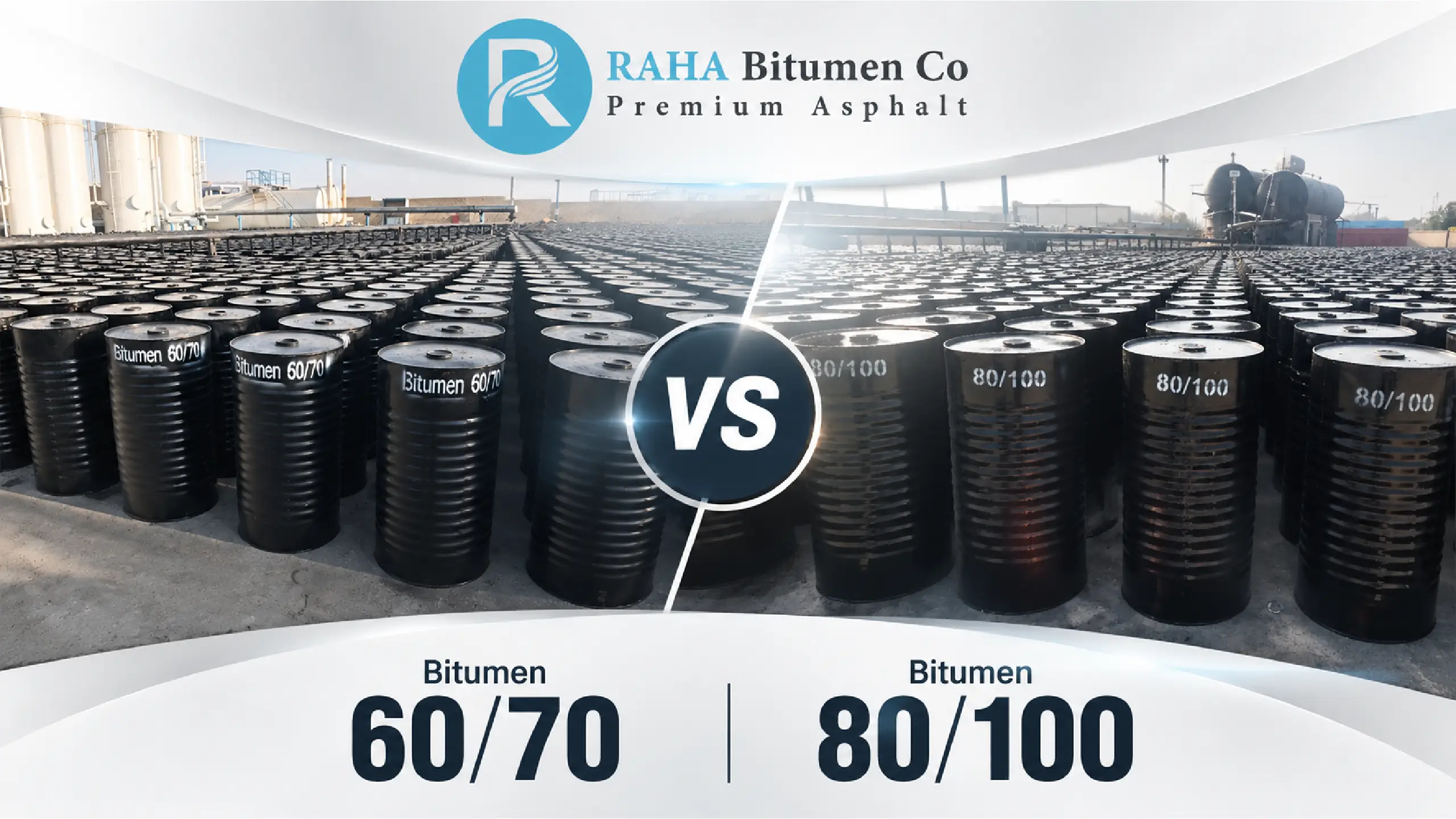
Comparison and Differences of Bitumen 60/70 vs 80/100
Choosing between Bitumen 60/70 vs 80/100 is one of the most common — and most consequential — decisions in road construction procurement. Get it right and your pavement performs for decades. Get it wrong and you face rutting, cracking, and costly early rehabilitation.
This guide covers everything: technical specifications, climate suitability by region, traffic load requirements, pricing dynamics, packaging options, quality testing, export documentation, and the exact scenarios where each grade belongs. Whether you are a project engineer, procurement manager, or bitumen importer, this is the only reference you need.
Quick Answer: Bitumen 60/70 vs 80/100
| Factor | Bitumen 60/70 | Bitumen 80/100 |
|---|---|---|
| Hardness | Harder, stiffer binder | Softer, more flexible binder |
| Best Climate | Warm to very hot (25–50°C+) | Temperate to cold (−5 to 25°C) |
| Traffic Load | Medium to heavy traffic | Light to medium traffic |
| Global Usage | ~70% of global road bitumen | ~20% of global road bitumen |
| Primary Markets | Asia, Middle East, Africa, South America | Europe, Central Asia, cold-climate regions |
| Failure Mode if Wrong | Rutting and deformation in cold climates | Thermal cracking and fatigue in hot climates |
The core rule: Higher penetration number = softer bitumen = better for cold climates. Lower penetration number = harder bitumen = better for hot climates and heavy traffic. The penetration number is not a quality ranking — both grades are correct when matched to the right conditions.
1. What Is Penetration Grade Bitumen?
Penetration grade bitumen is classified by the penetration test (ASTM D5 / EN 1426), which measures how deep a standard needle penetrates the bitumen sample at 25°C under a 100g load for 5 seconds. The result is expressed in tenths of a millimeter (dmm).
This simple test captures the binder’s stiffness at typical pavement service temperatures and has been the global standard for bitumen grading since the early 20th century. It remains the most widely used grading system in export markets across Asia, the Middle East, and Africa — despite the emergence of more sophisticated systems like Viscosity Grade (VG) and Superpave Performance Grade (PG).
How the Penetration Number Translates to Performance
| Penetration Range | Grade | Stiffness | Climate Fit |
|---|---|---|---|
| 40–50 dmm | 40/50 | Very hard | Extreme hot desert |
| 60–70 dmm | 60/70 | Hard–medium | Warm to hot climates |
| 80–100 dmm | 80/100 | Medium–soft | Temperate to cool climates |
| 120–150 dmm | 120/150 | Soft | Cold climates |
| 160–220 dmm | 160/220 | Very soft | Sub-arctic climates |
2. Comparing Bitumen 60/70 vs 80/100: Full Technical Specifications
The following specifications cover both ASTM D946 (North American standard) and EN 12591 (European standard). Most export markets, including Iran, accept both.
Bitumen 60/70 — Complete Specification (ASTM D946 / EN 12591)
| Property | Test Method | Unit | Specification |
|---|---|---|---|
| Penetration at 25°C | ASTM D5 / EN 1426 | dmm (0.1 mm) | 60–70 |
| Softening Point (Ring & Ball) | ASTM D36 / EN 1427 | °C | 49–56 |
| Ductility at 25°C | ASTM D113 | cm | ≥ 100 |
| Flash Point (Cleveland) | ASTM D92 | °C | ≥ 232 |
| Solubility in TCE | ASTM D2042 | % | ≥ 99 |
| Specific Gravity at 25°C | ASTM D70 | g/cm³ | 1.01–1.06 |
| Loss on Heating (TFOT) | ASTM D1754 | % wt | ≤ 0.5 |
| Penetration after TFOT | ASTM D5 | % of original | ≥ 54 |
| Ductility after TFOT | ASTM D113 | cm | ≥ 50 |
| Wax Content (Marcusson) | IP 23 / EN 12606 | % | ≤ 2.0 |
| Kinematic Viscosity at 135°C | ASTM D2170 | cSt | ≥ 150 |
Bitumen 80/100 — Complete Specification (ASTM D946 / EN 12591)
| Property | Test Method | Unit | Specification |
|---|---|---|---|
| Penetration at 25°C | ASTM D5 / EN 1426 | dmm (0.1 mm) | 80–100 |
| Softening Point (Ring & Ball) | ASTM D36 / EN 1427 | °C | 45–52 |
| Ductility at 25°C | ASTM D113 | cm | ≥ 100 |
| Flash Point (Cleveland) | ASTM D92 | °C | ≥ 232 |
| Solubility in TCE | ASTM D2042 | % | ≥ 99 |
| Specific Gravity at 25°C | ASTM D70 | g/cm³ | 1.00–1.05 |
| Loss on Heating (TFOT) | ASTM D1754 | % wt | ≤ 0.5 |
| Penetration after TFOT | ASTM D5 | % of original | ≥ 50 |
| Ductility after TFOT | ASTM D113 | cm | ≥ 75 |
| Wax Content (Marcusson) | IP 23 / EN 12606 | % | ≤ 2.0 |
| Kinematic Viscosity at 135°C | ASTM D2170 | cSt | ≥ 125 |
Key Differences at a Glance
| Property | 60/70 | 80/100 | Significance |
|---|---|---|---|
| Softening Point | 49–56°C | 45–52°C | 60/70 resists heat better — critical in hot climates |
| Penetration | 60–70 dmm | 80–100 dmm | 80/100 is softer and more flexible at low temperatures |
| Ductility after TFOT | ≥ 50 cm | ≥ 75 cm | 80/100 retains more flexibility after aging |
| Kinematic Viscosity at 135°C | ≥ 150 cSt | ≥ 125 cSt | 60/70 is more viscous — better film coating on aggregate |
3. Bitumen 60/70 vs 80/100: Climate Suitability by Region
Bitumen 60/70 vs Bitumen 80/100
Climate is the single most critical factor in selecting between these two grades. Pavement surface temperatures regularly exceed ambient air temperature by 20–30°C — a road in a country with 40°C summers may experience surface temperatures of 60–65°C, far above the softening point of 80/100 bitumen.
🌵 Extreme Hot & Desert Climates — 60/70 Required
Countries: UAE, Saudi Arabia, Qatar, Kuwait, Oman, Iraq, southern Iran, Egypt, Libya, Sudan, Rajasthan (India)
Pavement surface temperatures routinely exceed 60°C in summer. Bitumen 80/100 with a softening point of 45–52°C will soften and deform under traffic loads, causing permanent rutting within 1–2 seasons. Bitumen 60/70 is the minimum specification for these conditions — and for high-traffic highways in this climate zone, PMB or VG-40 should be considered.
☀️ Hot Tropical & Sub-Tropical Climates — 60/70 Standard
Countries: Nigeria, Ghana, Kenya, Tanzania, Ethiopia, Mozambique, Vietnam, Thailand, Philippines, Indonesia, Malaysia, Bangladesh, Sri Lanka, Pakistan, northern Brazil, Colombia
The global default specification. Bitumen 60/70 provides the right balance of heat resistance and workability for tropical monsoon, equatorial, and humid subtropical climates. Virtually all government road specifications in these regions mandate 60/70 as the standard penetration grade.
🌤️ Warm Mediterranean & Semi-Arid — 60/70 Preferred
Countries: Turkey, Morocco, Algeria, Tunisia, South Africa (low altitude), Iran (central & northern), Iraq (highland), Jordan, Lebanon
60/70 remains the correct specification for most applications. In highland areas or at elevations above 1,500m where night temperatures drop significantly, 80/100 may be appropriate for secondary roads with light traffic.
🌿 Temperate Continental — Both Grades Used
Countries: Romania, Bulgaria, Poland, Hungary, Serbia, Ukraine, northern Turkey, northern Iran (Tabriz region), Central Asian highlands
The choice depends on summer peak temperatures and traffic load. For primary highways with heavy traffic, 60/70 is typically specified to resist summer rutting. For secondary roads and applications where winter flexibility is the primary concern, 80/100 is appropriate. Many projects in this zone use both grades for different layers.
❄️ Cold & Sub-Arctic Climates — 80/100 or Softer
Countries: Northern Europe (Norway, Sweden, Finland, Estonia, Latvia, Lithuania), Russia, Kazakhstan, Kyrgyzstan, Tajikistan, northern China
80/100 is the minimum softness for these regions — in sub-arctic conditions, even softer grades (120/150 or 160/220) may be necessary. Using 60/70 in severe cold climates results in thermal cracking as the binder becomes brittle and fails under freeze-thaw cycling.
Regional Grade Recommendation Table
| Region / Country | Climate Type | Recommended Grade | Notes |
|---|---|---|---|
| UAE, Saudi Arabia, Qatar, Kuwait | Extreme hot desert | 60/70 (PMB for highways) | Surface temp regularly exceeds 65°C |
| Nigeria, Ghana, Ivory Coast | Tropical hot & humid | 60/70 | Government specs mandate 60/70 |
| Kenya, Tanzania, Ethiopia | Tropical highlands | 60/70 | Elevation may allow 80/100 for secondary roads |
| Vietnam, Thailand, Philippines | Tropical monsoon | 60/70 | High rainfall — good adhesion critical |
| Indonesia, Malaysia | Equatorial hot | 60/70 | Year-round high temperatures |
| Pakistan, Bangladesh | Tropical/subtropical | 60/70 | BIS-equivalent specs align with 60/70 |
| India (plains) | Tropical hot | VG-30 / 60/70 | VG-30 is IS 73 equivalent to 60/70 |
| Egypt, Morocco, Algeria | Arid Mediterranean | 60/70 | North African government standard |
| Turkey | Mixed (coast warm, interior cold) | 60/70 or 80/100 | Depends on region and altitude |
| Romania, Poland, Bulgaria | Continental cold winters | 80/100 | EN 12591 compliance required |
| Kazakhstan, Uzbekistan | Continental extreme range | Both / PMB | Depends on elevation and season |
| Brazil (north) | Tropical humid | 60/70 | Amazon regions may use emulsion grades |
| Colombia, Peru (coastal) | Subtropical | 60/70 | Andes highlands may require softer grades |
| South Africa | Mixed subtropical | 60/70 | Highveld elevation may allow 80/100 |
| Russia, Northern Kazakhstan | Sub-arctic continental | 80/100 or softer | Freeze-thaw resistance is primary concern |
4. Application by Use Case: When to Use Each Grade
Bitumen 60/70 — Primary Applications
| Application | Why 60/70 | Climate Condition |
|---|---|---|
| National highways & expressways | Rut resistance under heavy axle loads | Warm to very hot |
| Airport runways & taxiways | Resistance to aircraft wheel loads and solar heating | Any warm climate |
| Port & container terminal surfaces | Sustained slow-moving heavy loads require stiff binder | Warm to hot |
| Hot mix asphalt (HMA) surface course | Hard aggregate coating at mixing temperatures | Tropical and warm climates |
| Industrial & heavy-duty pavements | Resistance to deformation under static loads | Any non-arctic climate |
| Urban arterials & bus corridors | Resistance to rutting at bus stops and intersections | Warm to hot |
| Dense graded asphalt (DBM/BC layers) | Standard binder for dense mixes in warm climates | Tropical and warm |
Bitumen 80/100 — Primary Applications
| Application | Why 80/100 | Climate Condition |
|---|---|---|
| Secondary & rural roads | Lower traffic load, flexibility more important than rut resistance | Temperate to cool |
| Cold-climate primary highways | Flexibility at low temperatures prevents thermal cracking | Cold continental, northern Europe |
| Crack sealing & road maintenance | Softer grade flows into cracks more effectively | Any temperate climate |
| Waterproofing underlayers | Flexibility and membrane properties in non-traffic areas | Any climate |
| Roofing base applications | Thermal flexibility for roof membranes | Temperate climates |
| Industrial flooring (light loads) | Adequate stiffness for pedestrian and light vehicle areas | Any non-extreme climate |
| EN 12591-compliant projects | European-funded projects may specify 80/100 per EN standard | Eastern Europe, Central Asia |
| Cold-mix applications | Softer grade mixes at lower temperatures without excessive heating | Cold climates |
5. Critical Quality Parameters: What to Test and Why
Not all bitumen sold as “60/70” or “80/100” meets specification. Quality varies significantly between refineries, production batches, and suppliers. These are the tests that matter most for buyers and specifying engineers:
1. Penetration Test (ASTM D5 / EN 1426)
What it measures: Needle depth at 25°C — the defining test for the grade.
What to watch for: Results outside the specified range (60–70 dmm or 80–100 dmm) indicate off-spec material. Some suppliers blend or cut product to hit target penetration — always test independently.
2. Softening Point (ASTM D36 / EN 1427)
What it measures: The temperature at which bitumen softens enough to flow — directly related to maximum service temperature.
What to watch for: For 60/70, softening point below 49°C is a red flag indicating softer-than-specified material. This is critical for hot-climate buyers — a softening point of 47°C means the binder will begin to deform at pavement surface temperatures common in the Gulf and tropical Africa.
3. Wax Content (IP 23 / EN 12606)
What it measures: Percentage of wax (paraffin) in the bitumen.
What to watch for: Wax content above 2% significantly reduces ductility, adhesion to aggregate, and cold-temperature flexibility. High-wax bitumen from certain refineries or feedstocks is one of the most common quality issues in traded bitumen. Always specify wax content ≤ 2% and verify with COA from an independent inspector (SGS, Intertek, Cotecna).
4. Ductility (ASTM D113)
What it measures: How far a bitumen sample can be stretched before breaking — a measure of flexibility and cohesion.
What to watch for: Ductility below 100 cm (before TFOT) or below specification limits after TFOT indicates aged or degraded material. Low ductility bitumen will crack prematurely in service, especially in cooler seasons or at night.
5. Loss on Heating / TFOT (ASTM D1754)
What it measures: Weight loss after heating — simulates aging during mixing and compaction.
What to watch for: Loss above 0.5% indicates bitumen that will age and harden rapidly in the asphalt plant and during early service life. This is particularly important for buyers in hot climates where mixing temperatures are higher.
6. Flash Point (ASTM D92)
What it measures: Temperature at which vapors ignite — a safety parameter.
What to watch for: Flash point below 232°C is a safety concern and may indicate contamination with lighter petroleum fractions. Also affects compliance with transport regulations.
7. Kinematic Viscosity at 135°C (ASTM D2170)
What it measures: Flowability at mixing temperature — determines whether the bitumen will coat aggregate adequately in the plant.
What to watch for: Values below 150 cSt (60/70) or 125 cSt (80/100) indicate bitumen that may not provide adequate film thickness on aggregate at normal mixing temperatures.
Mandatory documentation for every shipment: Certificate of Analysis (COA) covering all parameters above, issued by or verified by an independent inspection body (SGS, Intertek, Bureau Veritas, or Cotecna). A COA from the refinery alone, without independent verification, is insufficient for quality assurance on critical infrastructure projects.
6. ASTM D946 vs EN 12591: Which Standard Applies?
This is one of the most commonly overlooked issues in international bitumen procurement. Both standards cover 60/70 and 80/100 penetration grades, but with different test methods and limit values. Specifying the wrong standard — or not specifying at all — can create compliance problems on funded infrastructure projects.
| Aspect | ASTM D946 | EN 12591 |
|---|---|---|
| Origin | United States (ASTM International) | Europe (CEN) |
| Primary Markets | USA, Iran, most Asia/Africa/ME export markets | EU, Eastern Europe, EU-funded projects globally |
| Grade 60/70 | Pen 60–70, SP 49–56°C | Pen 50–70, SP 46–54°C (grade 50/70) |
| Grade 80/100 | Pen 80–100, SP 45–52°C | Pen 70–100, SP 43–51°C (grade 70/100) |
| Wax Content | Not specified in D946 | Max 2.2% (EN 12591) |
| CE Marking | Not applicable | Required for EU construction products |
| When to use | Most export markets, Iranian supply | EU-funded projects, Eastern European highways |
Important for buyers: If your project is funded by the European Union, World Bank (for European-standard projects), or requires CE marking, specify EN 12591 explicitly. Iranian bitumen can meet EN 12591 requirements and should be supplied with EN-compliant COA when required.
7. Packaging Options: Drums, Jumbo Bags, and Bulk
Bitumen 60/70 vs Bitumen 80/100
The choice of packaging affects price, handling, storage, and suitability for different project scales. Understanding the options is essential for accurate cost comparison and logistics planning.
Steel Drums — 150kg and 185kg
Capacity: 150 kg (standard) or 185 kg (oversize)
Container load: Approximately 80 drums × 185 kg = ~14.8 MT per 20ft container
MOQ: 1 × 20ft container (~14–15 MT)
Best for: Small to medium projects, remote sites without bulk infrastructure, markets with limited unloading equipment, spot purchases
Advantages: Easy handling, stackable storage, no special heating required for storage, resaleable packaging
Disadvantages: Highest per-tonne packaging cost, labor-intensive unloading, drum disposal at destination
Heating to liquefy: Required before use — drums must be heated to 160–180°C in a drum melter or heated bath
New Steel Drums vs Reconditioned Drums
Bitumen is commonly shipped in both new and reconditioned (used) steel drums. Reconditioned drums are cleaned, repainted, and tested before refilling. For standard penetration grade bitumen, reconditioned drums are technically acceptable and significantly reduce packaging cost. For food-grade applications or projects with strict contamination requirements, new drums are mandatory.
Jumbo Bags (Bitutainer / Big Bag) — 1 MT
Capacity: 1,000 kg (1 MT) per bag
Container load: 20 MT per 20ft container (20 bags)
MOQ: 1 × 20ft container (20 MT)
Best for: Medium projects, sites with forklift access, buyers wanting to avoid drum disposal costs
Advantages: Lower packaging cost than drums, easier bulk handling, no drum disposal, uniform 1 MT units simplify inventory
Disadvantages: Requires forklift for handling, bag disposal at destination, some markets have limited familiarity with this format
Heating: Bags are placed in heated frames or melting equipment at site
Bulk Vessel Shipment
Capacity: 1,000 MT minimum (small product tanker) up to 5,000–10,000 MT per vessel
MOQ: Typically 1,000 MT for vessel charter or parcel
Best for: Large infrastructure projects, refineries, asphalt plants with bulk storage tanks, regular large-volume buyers
Advantages: Lowest per-tonne delivered cost, no packaging material, continuous supply for large operations
Disadvantages: Requires heated bitumen storage tanks at destination port, high MOQ, longer lead time for vessel scheduling
Discharge: Heated bitumen pumped from vessel tanks to shore storage via insulated pipeline
Packaging Cost Comparison (Approximate)
| Format | Typical Packaging Premium | MOQ | Best For |
|---|---|---|---|
| New steel drums (185kg) | +$40–60/MT over bulk | ~15 MT (1 × 20ft) | Small projects, spot buyers |
| Reconditioned drums (185kg) | +$20–35/MT over bulk | ~15 MT (1 × 20ft) | Cost-sensitive small orders |
| Jumbo bags (1 MT) | +$15–25/MT over bulk | 20 MT (1 × 20ft) | Medium projects |
| Bulk vessel | Base price (no packaging) | 1,000 MT+ | Large projects, distributors |
8. Pricing: What Drives the Cost of Bitumen 60/70 and 80/100
In most market conditions, Bitumen 60/70 and 80/100 are priced at parity — within $5/MT of each other FOB Bandar Abbas. The pricing differential between grades is minimal compared to the factors that drive the overall bitumen price level.
Primary Price Drivers
1. Crude Oil Price: Bitumen is a refinery residue — its production cost moves directly with crude oil prices. A $10/barrel move in crude oil typically translates to a $15–25/MT move in bitumen prices.
2. Iranian Rial / USD Exchange Rate: Iranian bitumen exports are priced in USD but produced at Rial-denominated costs. Exchange rate movements significantly affect the competitive position of Iranian supply in global markets.
3. Export Volume and Refinery Output: Seasonal demand peaks (Q2–Q3 construction season in the Northern Hemisphere) tighten supply and support prices. Refinery maintenance shutdowns reduce available supply.
4. Competing Supply Sources: Iranian bitumen competes with supplies from South Korea, Singapore, Turkey, and European refineries in some markets. When competing supply is limited or priced higher, Iranian prices firm up.
5. Packaging: As detailed above, drummed bitumen commands a premium of $20–60/MT over bulk FOB prices.
6. Shipping and Freight: Ocean freight from Bandar Abbas varies significantly by destination. West Africa, South-East Asia, and East Africa represent different freight cost profiles that materially affect CFR/CIF landed cost.
Price Reference Points (Indicative)
For current FOB Bandar Abbas prices, contact RAHA Bitumen directly — bitumen prices change weekly and any published price in an article may be outdated within days. The Raha Bitumen price page is updated regularly with indicative market levels.
Buyer mistake to avoid: Do not choose the wrong grade because it is slightly cheaper. Since 60/70 and 80/100 are priced at parity, there is no financial justification for using an incorrect grade. Using 80/100 in a hot climate to save $3/MT will result in pavement failure and rehabilitation costs that are 10–50× the savings.
9. Export Documentation: What You Need to Import Bitumen
For buyers importing bitumen for the first time — or entering a new destination market — understanding the required documentation is essential to avoid costly delays at customs.
Standard Export Documents (All Markets)
| Document | Purpose | Issued By |
|---|---|---|
| Certificate of Analysis (COA) | Confirms product meets specification — all test parameters | Refinery + Independent Inspector (SGS/Intertek) |
| Material Safety Data Sheet (MSDS/SDS) | Safety information for transport, handling, and storage | Supplier |
| Commercial Invoice | Value declaration for customs clearance | Supplier/Exporter |
| Packing List | Details of packages, weights, and marks | Supplier/Exporter |
| Certificate of Origin | Confirms country of manufacture for customs duty purposes | Chamber of Commerce / Trade body |
| Bill of Lading (B/L) | Shipping contract and title document | Shipping Line |
| Independent Inspection Certificate | Third-party quantity and quality verification at loading | SGS, Intertek, Bureau Veritas, Cotecna |
Additional Documents for Specific Markets
| Market / Requirement | Additional Document | Notes |
|---|---|---|
| East Africa (Kenya, Tanzania, Ethiopia) | Pre-Export Verification of Conformity (PVoC) | Required for KEBS, TBS, and Ethiopian standards compliance |
| West Africa (Nigeria, Ghana) | NAFDAC / SON product registration (Nigeria) | May be required for certain bitumen applications |
| EU / EN 12591 projects | Declaration of Performance (DoP) + CE Marking | Required for EU construction products regulation |
| India | BIS (Bureau of Indian Standards) compliance | IS 73:2013 or IS 8887 for applicable grades |
| Pakistan | PSQCA conformity certificate | Required for government project specifications |
| Most markets | Fumigation Certificate (for wooden pallets if used) | Required under ISPM-15 phytosanitary regulations |
10. Incoterms: FOB vs CFR vs CIF — What Buyers Need to Know
Understanding trade terms is essential for accurate cost comparison between suppliers. All three terms are commonly used in bitumen export from Iran.
FOB (Free on Board) — Bandar Abbas or other origin port: The seller’s responsibility ends when the goods are loaded onto the vessel at the origin port. The buyer arranges and pays for ocean freight and marine insurance. FOB is the most transparent basis for comparing suppliers — it strips out freight differences and gives you the true product price.
CFR (Cost and Freight) — Named destination port: The seller covers ocean freight to your named destination port but not marine insurance. You bear the risk of loss or damage during transit. CFR is useful for buyers who want a single delivered price but should be converted to FOB equivalent when comparing multiple suppliers serving different origin ports.
CIF (Cost, Insurance and Freight) — Named destination port: The seller covers freight AND marine insurance to your destination port. This is the most comprehensive seller responsibility under conventional Incoterms. CIF prices are the easiest to compare on a landed basis but may include insurance cost mark-ups.
CPT / DAP / DDP: Less common in bulk bitumen trade but sometimes used for drummed shipments to land-locked countries or specific project sites.
Practical advice: Always request FOB Bandar Abbas prices when comparing Iranian suppliers. Then add your own freight and insurance quotes to calculate comparable landed cost. This prevents suppliers from using different freight quotes to obscure real product price differences.
11. Bitumen 60/70 vs 80/100: The Most Common Buyer Mistakes
Mistake 1: Choosing Grade by Price
Since 60/70 and 80/100 are priced at virtual parity, there is no financial justification for using the wrong grade. The cost of pavement failure — rehabilitation, traffic disruption, loss of reputation for contractors — vastly exceeds any minimal price difference between grades.
Mistake 2: Ignoring Softening Point Within a Grade
Not all 60/70 bitumen is equal. A 60/70 with a softening point of 50°C and one with a softening point of 55°C are both within specification — but behave very differently at 60°C pavement surface temperature. For hot climate buyers, always request the actual softening point from the COA, not just grade confirmation.
Mistake 3: Overlooking Wax Content
High wax content (above 2%) reduces adhesion, ductility, and low-temperature performance. It is one of the most common quality differentiators between refineries and production runs. Always specify “wax content ≤ 2% per EN 12606” in your purchase order, regardless of which grade you are buying.
Mistake 4: Not Specifying the Standard
ASTM D946 and EN 12591 classify grades slightly differently. For EU-funded projects or European standard requirements, failing to specify EN 12591 compliance can create contractual and customs problems.
Mistake 5: Accepting COA Without Independent Verification
A supplier-issued or refinery-issued COA alone is insufficient quality assurance for critical infrastructure projects. Always require independent third-party inspection (SGS, Intertek, Bureau Veritas) at the point of loading, covering both quantity and quality against the specified standard.
Mistake 6: Ordering 80/100 for Hot Climate Projects
Buyers in hot climates sometimes order 80/100 believing it is more flexible and therefore “better.” This is incorrect. 80/100’s lower softening point means it will deform under traffic loads at temperatures common in the Middle East, Africa, and South Asia. Flexibility in cold climates is a benefit; softness in hot climates causes pavement failure.
Mistake 7: Not Considering PMB for High-Traffic Applications
For national highways, airport runways, and heavily trafficked urban roads in hot climates, standard 60/70 may be insufficient. Polymer Modified Bitumen (PMB) adds 25–50% in material cost but can multiply pavement service life by 2–3×, delivering far better lifecycle economics. Not considering PMB for high-traffic applications in demanding climates is a missed opportunity for project engineers and specifiers.
12. When to Upgrade from 60/70 to PMB or VG-40
Bitumen 60/70 vs Bitumen 80/100
Standard Bitumen 60/70 has performance limits. In certain conditions, specifying it is an under-specification that will lead to premature failure. Consider upgrading when:
| Condition | Issue with 60/70 | Recommended Upgrade |
|---|---|---|
| Highway with > 1,000 heavy vehicles/day in hot climate | Progressive rutting under sustained axle loads | PMB 40/60-65 or VG-40 |
| Airport runway or apron | Aircraft loads + fuel spillage exceed 60/70 capability | PMB 25/55-65 or PMB 10/40-70 |
| Summer surface temperature regularly > 65°C | Softening point of 60/70 (49–56°C) exceeded | VG-40 or PMB |
| Bridge deck or structural pavement | Flexural movement requires elastic recovery | SBS-PMB (high elastic recovery) |
| Continental climate (hot summer + cold winter) | Single grade cannot address both failure modes | PMB with wide PG span |
| Bus stops, intersections, loading zones | Concentrated static/slow-moving loads cause local rutting | PMB 40/60-65 |
For a complete guide on PMB and CRMB selection across all climate and traffic conditions, see our Bitumen Grade Selection Guide.
Frequently Asked Questions: Bitumen 60/70 vs 80/100
Can I substitute 80/100 for 60/70 in a hot climate?
No. Bitumen 80/100 has a lower softening point (45–52°C) compared to 60/70 (49–56°C). In climates where road surface temperatures exceed 55–60°C — common across the Middle East, South Asia, and tropical Africa — 80/100 will soften and deform under traffic loads, causing rutting and early pavement failure. Always use 60/70 or harder grades in hot climates.
Can I use 60/70 in a cold climate like Eastern Europe?
It is not recommended for cold-climate primary applications. In regions with winter temperatures below −10°C, 60/70’s relative stiffness makes it prone to thermal cracking. The binder becomes brittle at low temperatures and fails under freeze-thaw cycling. 80/100 or softer grades (120/150) are the correct specification for cold-climate road construction.
What is the difference between 60/70 ASTM and 60/70 EN?
ASTM D946 specifies a softening point of 49–56°C for 60/70. EN 12591 does not have an exact 60/70 equivalent — the closest EN grade is 50/70, with a softening point of 46–54°C. For most export markets, ASTM D946 compliance is standard. For EU-funded or European-specification projects, EN 12591 compliance is required — confirm with the project specification before ordering.
Is Iranian bitumen 60/70 equivalent in quality to European grades?
Iranian bitumen from major refineries (Jey Oil, Pasargad, Isfahan) meets ASTM D946 and can be produced to EN 12591 specification. The key quality differentiator between Iranian refineries is wax content — some Iranian crude feedstocks produce higher-wax bitumen that must be carefully managed. Always request SGS or Intertek COA with wax content data when buying Iranian bitumen for quality-sensitive applications.
What is the minimum order quantity (MOQ) for export?
For drummed bitumen (150kg or 185kg steel drums): MOQ is typically one 20ft container, approximately 14–20 MT depending on drum size. For jumbo bags (1 MT bags): MOQ is one 20ft container, approximately 20 MT. For bulk vessel shipments: typically 1,000 MT minimum (one small product tanker), with vessels ranging up to 5,000–10,000 MT. RAHA Bitumen handles all three formats and can advise on consolidation options for smaller orders to certain destination ports.
What documents do I need when importing bitumen?
At minimum: Certificate of Analysis (COA) with batch number, Material Safety Data Sheet (MSDS), commercial invoice, packing list, certificate of origin, bill of lading, and an independent inspection certificate (SGS, Intertek, or equivalent). Additional market-specific requirements may include PVoC (East Africa), BIS compliance (India), or CE marking documentation (EU-funded projects). See Section 9 of this guide for the complete documentation checklist by market.
What is PMB and when should I use it instead of 60/70?
Polymer Modified Bitumen (PMB) is 60/70 or similar base bitumen enhanced with SBS, EVA, or SBR polymers to achieve higher performance grade (PG) ratings. It is used for high-traffic highways, airport pavements, bridge decks, and projects in climates with extreme temperature ranges where standard 60/70 reaches its performance limits. PMB costs 25–50% more than standard 60/70 but significantly extends pavement service life in demanding conditions. See our complete Bitumen Grade Selection Guide for PMB specifications and application guidance.
How is bitumen price quoted and what affects it?
Bitumen is typically quoted FOB (origin port) in USD per metric tonne. Prices change weekly, driven primarily by crude oil price, refinery output, the USD/IRR exchange rate (for Iranian supply), seasonal demand, and ocean freight rates. The premium between 60/70 and 80/100 is minimal — typically within $5/MT. Contact RAHA Bitumen for current price indications.
The Bottom Line: Bitumen 60/70 vs 80/100
For the vast majority of road construction projects in Asia, the Middle East, Africa, and South America, Bitumen 60/70 is the correct and most widely specified grade. It offers the right balance of hardness, rut resistance, and workability under heat and traffic — which is why it accounts for approximately 70% of global road bitumen volume.
Bitumen 80/100 serves a clear and important purpose: cold-climate road construction, lighter-duty applications, European standard projects, and specific maintenance and waterproofing applications. In those scenarios, it is the correct choice — not a compromise.
The golden rule: match the grade to the specification, not to the price or availability. A $5/MT saving on the wrong grade can translate into millions of dollars in premature pavement rehabilitation and reputational damage for contractors and project owners.
When the specification calls for something beyond standard penetration grades — due to extreme climate, very heavy traffic, or structural application requirements — consider upgrading to Polymer Modified Bitumen (PMB) or CRMB before committing to a standard grade specification.
Key Takeaways
- Higher penetration number = softer bitumen = better for cold climates
- 60/70 is the global default for hot and tropical climates — approximately 70% of global road bitumen volume
- 80/100 is correct for cold-climate paving, lighter-duty applications, and EN 12591 projects
- Both grades are priced at parity — choose by specification, not price
- Always verify wax content ≤ 2% and require independent SGS/Intertek COA
- For high-traffic highways and airports in hot climates, evaluate PMB before defaulting to 60/70
- RAHA Bitumen supplies both grades in drum, jumbo bag, and bulk formats from Bandar Abbas
