
Oxidized Bitumen for Dam & Canal Lining: Complete Guide, Best Grades & Installation
Oxidized Bitumen dam canal lining is one of the most proven solutions for preventing water seepage in hydraulic structures worldwide. — also known as blown bitumen or blown asphalt — has been a proven solution for hydraulic structure waterproofing and canal lining for over a century. Its exceptional impermeability, chemical resistance, durability under hydrostatic pressure, and proven performance in water-contact environments make it one of the most reliable and cost-effective materials for protecting dams, irrigation canals, reservoirs, and water retention structures from seepage and water loss.
The global water crisis makes canal and dam lining more critical than ever. Irrigation canals worldwide lose between 10% and 70% of their total water to seepage before it ever reaches crops (ScienceDirect, 2023). Since irrigated agriculture accounts for approximately 70% of all global freshwater withdrawals, every percentage point of efficiency gained through canal lining represents millions of cubic meters of water saved annually. A 2025 peer-reviewed study published in AQUA journal found that canal lining reduces seepage losses by 60–80%, with a benefit-cost ratio of up to 4.02 — making it one of the most economically sound investments in water infrastructure.
In this complete technical guide, RAHA Bitumen’s engineering team explains everything about using oxidized bitumen for dam and canal lining: the hydraulic applications, installation methods, grade selection, applicable standards, and how to choose the right system for your project.
Why Oxidized Bitumen Is Ideal for Dam & Canal Lining
Not all waterproofing materials are suitable for hydraulic structures. Dams, canals, reservoirs, and irrigation systems operate under demanding conditions: constant water contact, varying water levels, soil movement, UV exposure, temperature cycling, and sometimes aggressive water chemistry. Oxidized bitumen meets these demands through a unique set of properties developed during the air-blowing oxidation process.
Key properties that make oxidized bitumen ideal for hydraulic lining:
- Near-zero water permeability: The dense, cross-linked molecular structure formed during oxidation creates an almost completely impermeable barrier — critical for preventing seepage in canals, reservoirs, and dam faces.
- High softening point (85°C–150°C): Prevents softening and flow in hot climates where canal surfaces can reach extreme temperatures. Essential for tropical and arid region irrigation infrastructure.
- Excellent adhesion to concrete and masonry: Bonds firmly to the concrete and masonry substrates used in canal linings and dam faces — critical for maintaining waterproofing integrity over decades.
- Chemical resistance: Resistant to the full range of naturally occurring water chemistry — dissolved salts, sulfates, carbonates, alkaline and acidic groundwater — commonly encountered in agricultural and industrial water systems.
- Flexibility and crack bridging: Minor structural movement, differential settlement, and thermal expansion are inevitable in hydraulic structures. Oxidized bitumen accommodates movement and bridges hairline cracks without losing waterproofing integrity.
- Biological resistance: Resists algae, fungi, and root penetration — important for structures in agricultural environments.
- Proven longevity: Bitumen-lined canals and dam faces regularly achieve service lives of 30–50+ years with minimal maintenance.
- Cost-effectiveness: Significantly lower material and installation cost than HDPE geomembrane, EPDM, or concrete lining systems — especially for large-area irrigation canal projects in emerging economies.
Hydraulic Applications of Oxidized Bitumen
1. Irrigation Canal Lining
Canal seepage is one of the most critical water loss problems in irrigated agriculture globally. Unlined canals can lose 30–50% of their water through seepage, while poorly lined systems still lose 10–20%. Oxidized bitumen canal lining systems reduce seepage losses by 60–80%, directly translating into water savings, reduced pumping costs, and increased irrigated area served by the same water source.
The problem oxidized bitumen solves:
- Unlined earth canals: seepage losses of 30–70%
- Poorly constructed concrete linings: crack within 5–10 years, seepage resumes
- Oxidized bitumen membrane lining: reduces seepage by 60–80%, service life 30–50 years
- Benefit-cost ratio of canal lining programs: 1.99 to 4.02 (AQUA Journal, 2025)
Typical application system:
- Compacted earth subgrade preparation
- Bitumen primer application to subgrade or concrete base
- Hot-applied oxidized bitumen membrane (two layers, minimum 6mm total)
- Protective cover layer (gravel, concrete tiles, or compacted soil)
Recommended grades: 90/40, 95/25
2. Dam Face & Embankment Waterproofing
Bitumen has been used in dam construction and rehabilitation for over 100 years. In earthfill and rockfill dams, oxidized bitumen membranes are applied to the upstream face to prevent water infiltration through the dam body — one of the primary causes of dam failure. In concrete gravity dams, bitumen membranes seal construction joints, cracks, and gallery walls.
Dam applications of oxidized bitumen:
- Upstream face membrane: Applied to the water-retaining face of earthfill and rockfill dams to prevent seepage through the dam body
- Construction joint sealing: Sealing joints between concrete dam blocks to prevent water infiltration
- Spillway waterproofing: Protecting concrete spillway channels from water erosion and freeze-thaw damage
- Dam gallery waterproofing: Sealing internal inspection galleries from groundwater infiltration
- Embankment slope protection: Protecting dam embankment slopes from wave action and rainfall erosion
According to ScienceDirect’s review of hydropower engineering materials, bituminous sealing membranes on dam faces provide waterproofing performance equivalent to approximately 3cm of bituminous conglomerate from a mechanical resistance standpoint — a proven and cost-effective solution for dam rehabilitation and new construction.
Recommended grades: 95/25, 105/35, 115/15
3. Reservoir & Water Storage Lining
Agricultural reservoirs, farm ponds, stormwater retention basins, and municipal water storage tanks require reliable waterproofing to prevent water loss through the base and walls. Oxidized bitumen membrane systems provide a continuous, seamless waterproof barrier that conforms to irregular base contours and withstands the hydrostatic pressure of stored water.
Types of reservoirs lined with oxidized bitumen:
- Farm irrigation reservoirs and ponds
- Municipal water supply storage reservoirs
- Stormwater detention and retention basins
- Industrial process water storage
- Fire water storage tanks
- Aquaculture ponds
Important note for potable water: For reservoirs storing drinking water, always verify that the oxidized bitumen product complies with potable water contact approvals (e.g., WRAS, NSF/ANSI 61) before specification.
Recommended grades: 90/40, 95/25
4. Irrigation Channel & Aqueduct Lining
Secondary and tertiary irrigation channels — the smaller distribution canals that carry water from main canals to individual fields — are the most vulnerable to seepage. Their large total surface area and typically unlined earth construction make them the primary source of water loss in irrigation systems. Oxidized bitumen membrane lining is the most cost-effective solution for these smaller channels.
Why bitumen membrane is preferred over concrete for small channels:
- More flexible — accommodates soil settlement without cracking
- Faster to install — no curing time required
- Lower cost per m² for small channel cross-sections
- Easier to repair — damaged sections can be patch-repaired with hot bitumen
- Better seals at channel joints and transitions
Recommended grades: 85/25, 90/40
5. Hydroelectric Power Station Waterproofing
Hydroelectric power stations involve numerous water-retaining and water-excluding structures: penstocks, surge tanks, powerhouse foundations, tailrace channels, and underground power caverns. Oxidized bitumen membranes are used for waterproofing concrete structures, sealing expansion joints, and protecting below-grade surfaces from groundwater infiltration.
Recommended grades: 95/25, 115/15
6. Drainage & Flood Control Channels
Flood control channels, drainage ditches, and stormwater management systems require durable lining to prevent erosion, maintain channel geometry, and reduce seepage into adjacent structures. Oxidized bitumen membrane or hot-applied bitumen provides a smooth, erosion-resistant lining surface.
Recommended grades: 90/40, 95/25
Oxidized Bitumen Dam & Canal Lining Systems – Types Explained
System 1: Hot-Applied Oxidized Bitumen Membrane
The most traditional and widely used system. Oxidized bitumen is melted and applied hot as a continuous liquid layer over the prepared substrate, forming a seamless, jointless membrane as it cools.
- Application temperature: 220°C–230°C
- Applied thickness: 3–6mm per layer, minimum two layers for hydraulic applications
- Reinforcement: Fiberglass or polyester mat embedded between layers for added tensile strength and crack resistance
- Best for: Canal linings, reservoir bases, dam faces, large horizontal areas
System 2: Torch-On Bitumen Membrane
Pre-manufactured oxidized bitumen membrane rolls, torch-applied using a propane torch to bond to the primed substrate. Provides consistent thickness and controlled material properties.
- Thickness: 3–6mm per layer
- Reinforcement: Polyester or fiberglass carrier mat within the membrane
- Best for: Canal walls, dam faces, areas requiring consistent membrane thickness
System 3: Modified Bitumen Membrane (APP/SBS)
Oxidized bitumen modified with APP or SBS polymer for enhanced flexibility, UV resistance, and low-temperature performance. Used in demanding hydraulic applications where standard oxidized bitumen may have temperature performance limitations.
- Best for: Canal linings in cold climates, dam faces exposed to UV, reservoir linings subject to large temperature swings
Step-by-Step Installation Guide – Oxidized Bitumen Canal Lining
Phase 1: Site Preparation
Step 1: Canal Excavation & Shaping
- Excavate canal to design cross-section dimensions
- Shape canal bed and sides to uniform gradient and cross-section
- Remove all large stones, roots, and sharp objects that could puncture the membrane
- Achieve a smooth, firm subgrade — no loose material
Step 2: Subgrade Compaction
- Compact subgrade to minimum 95% Proctor density
- Address any soft spots, voids, or unstable areas
- Allow subgrade to dry thoroughly — no standing water or excessive moisture before lining
- For highly permeable soils: apply a 100–150mm compacted clay or sand-cement layer first
Step 3: Concrete Base (If Specified)
- Some specifications require a lean concrete base (50–75mm) beneath the bitumen membrane
- Allow concrete to cure fully (minimum 7 days) before applying bitumen
- Surface must be dry, clean, and free of laitance before priming
Phase 2: Primer Application
Step 4: Bitumen Primer
- Apply bitumen primer to all prepared surfaces — canal bed, slopes, and transition zones
- Use brush, roller, or spray application for uniform coverage
- Target application rate: 0.2–0.4 L/m²
- Allow primer to dry completely and become tack-dry before membrane application (30–60 minutes typical)
- Do not apply if surface temperature is below 5°C or if rain is forecast
Phase 3: Membrane Application
Step 5: First Layer of Oxidized Bitumen
- Heat oxidized bitumen in calibrated kettle to application temperature: 220°C–230°C
- Never exceed 260°C — material degradation occurs
- Stir continuously during heating to ensure uniform temperature
- Pour or mop hot bitumen over the primed surface in a continuous, even layer
- Minimum first layer thickness: 3mm
- Work in sections to maintain material temperature throughout application
Step 6: Reinforcement Layer
- While first layer is still hot, embed fiberglass or polyester reinforcement mat into the bitumen
- Press mat firmly into molten bitumen ensuring complete embedment — no air pockets
- Overlap reinforcement mat joints by minimum 100mm
- Reinforcement increases tensile strength and crack-bridging ability of the finished membrane
Step 7: Second Layer of Oxidized Bitumen
- Apply second layer of hot bitumen immediately over reinforcement mat
- Minimum second layer thickness: 3mm
- Total minimum finished membrane thickness: 6mm for canal lining applications
- For dam face applications: minimum 8–10mm total thickness recommended
- Ensure complete coverage with no holidays, thin spots, or cold laps
Step 8: Canal Junction & Detail Work
- Apply additional reinforced membrane at all canal junction points, inlets, and outlets
- Ensure minimum 300mm overlap at all transitions and connections
- Pay special attention to canal corners — these are the most vulnerable points to cracking
- Seal all penetrations (pipes, gates, weirs) with additional bitumen membrane flashing, minimum 300mm overlap
Phase 4: Quality Control & Protection
Step 9: Inspection
- Visually inspect 100% of membrane surface for holidays, thin spots, tears, and unbonded areas
- Check membrane thickness at representative points using a calibrated gauge
- Test adhesion to substrate by spot peel test
- Mark and repair all defects before protective cover layer is applied
Step 10: Protection Layer
- Apply protection layer over the cured bitumen membrane to prevent UV degradation and mechanical damage
- Options: 50–75mm concrete topping slab, precast concrete tiles, compacted gravel (50–75mm), or geotextile protection mat
- For canal beds subject to flow velocity above 1.5 m/s: concrete topping is mandatory to prevent erosion of the membrane
- For low-velocity irrigation canals: compacted gravel or soil is often sufficient
Step 11: Curing & Commissioning
- Allow protection layer to cure before filling canal with water
- For concrete protection: minimum 7 days curing before water introduction
- Fill canal slowly for initial commissioning — rapid filling can cause hydraulic pressure damage to freshly applied membranes
- Inspect for leaks during initial filling and remediate immediately
Best Oxidized Bitumen Grades for Dam & Canal Lining
| Grade | Softening Point | Penetration | Best Hydraulic Application |
|---|---|---|---|
| 85/25 | ~85°C | ~25 dmm | Small irrigation channels, temperate climate canal lining, secondary and tertiary canals |
| 90/40 | ~90°C | ~40 dmm | Main irrigation canals, reservoirs, flexible lining systems, cold-climate hydraulic structures |
| 95/25 | ~95°C | ~25 dmm | Dam faces, hot-climate canal lining, reservoir waterproofing, most common grade for hydraulic use |
| 105/35 | ~105°C | ~35 dmm | Desert climate hydraulic structures, high-temperature service environments, dam faces in tropical regions |
| 115/15 | ~115°C | ~15 dmm | Extreme heat environments, APP membrane manufacturing for hydraulic use, dam faces in arid climates |
Most widely recommended grade for canal lining: 90/40 or 95/25
The 90/40 grade offers excellent flexibility for accommodating soil movement and thermal cycling in canal linings. The 95/25 grade provides higher heat resistance — preferred in the Middle East, Africa, and South Asia where canal surface temperatures can exceed 60°C in summer.
Oxidized Bitumen vs. Other Canal Lining Materials
| Lining Material | Material Cost | Installation | Seepage Reduction | Service Life | Best For |
|---|---|---|---|---|---|
| Oxidized Bitumen Membrane | Low | Simple, fast | 60–80% | 30–50 years | Irrigation canals, reservoirs, emerging markets |
| Concrete Lining | Medium | Complex, slow | 50–70% | 15–30 years (cracks) | High-velocity channels, urban drainage |
| HDPE Geomembrane | Medium-High | Specialized | 85–95% | 30–50 years | Reservoirs, tailings ponds, critical applications |
| Compacted Clay | Very Low | Simple | 30–60% | 10–20 years | Low-value, low-technology applications |
| Bentonite GCL | Medium | Moderate | 80–90% | 20–40 years | Reservoirs, ponds requiring low permeability |
Conclusion: For irrigation canals, farm reservoirs, and water infrastructure projects in price-sensitive markets (Africa, Middle East, South Asia, Central Asia), oxidized bitumen membrane delivers the best combination of seepage control, cost, installation ease, and proven longevity. For critical containment applications (tailings, hazardous waste), HDPE geomembrane is preferred.
Why Canal & Dam Lining Is More Critical Than Ever
1. Global Water Scarcity
The World Health Organization estimates that by 2025, half of the world’s population will be living in water-stressed areas. With irrigated agriculture consuming 70% of global freshwater, reducing canal seepage losses by even 20–30% through lining programs represents enormous water savings — equivalent to supplying millions of additional people or irrigating millions of additional hectares.
2. Climate Change Impact
Increasing temperatures, changing precipitation patterns, and more frequent droughts are placing unprecedented pressure on water infrastructure. Canal lining programs that improve water delivery efficiency are becoming a critical component of national water security strategies in water-scarce regions.
3. Food Security Demands
The United Nations FAO estimates that global food production must increase by 50% by 2050 to feed a projected population of 9.7 billion. Improving irrigation efficiency through canal lining — increasing the amount of water that reaches crops from any given water source — is one of the most direct paths to achieving this goal.
4. Infrastructure Investment Programs
Major infrastructure investment programs across Africa, Asia, and the Middle East include significant components for irrigation modernization and water infrastructure rehabilitation. India’s Pradhan Mantri Krishi Sinchayee Yojana, Egypt’s National Water Management Strategy 2030, and various World Bank and ADB-funded irrigation projects are all driving demand for canal lining materials including oxidized bitumen.
Why Source Oxidized Bitumen for Dam & Canal Lining from RAHA Bitumen?
RAHA Bitumen (RABIT) supplies oxidized bitumen to hydraulic engineering projects, irrigation authorities, dam construction companies, and waterproofing contractors in over 100 countries. Our hydraulic-grade oxidized bitumen offers:
- Pure air-blown production — no additives or fillers that could affect waterproofing performance
- Consistent grade specifications — tight softening point and penetration tolerances, verified by third-party testing
- Full technical documentation: TDS, MSDS, COA for every shipment
- Third-party inspection: SGS and Bureau Veritas available
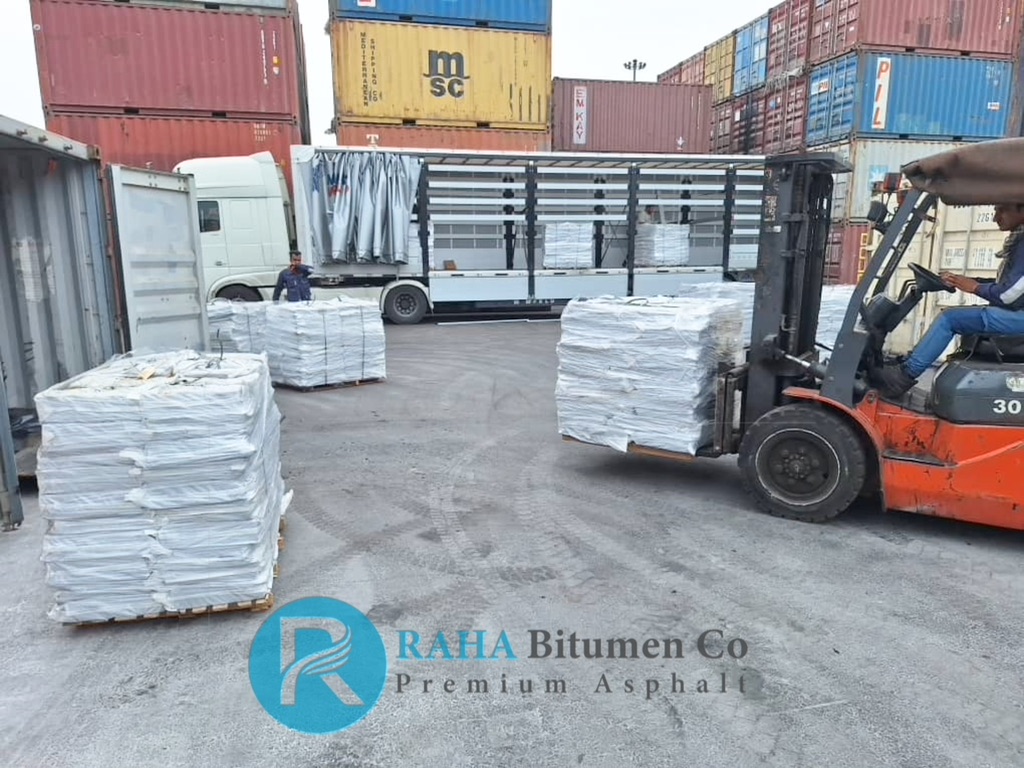
- Multiple packaging: 25kg meltable polyamide bags (most convenient for site application), kraft bags, 200L drums, bulk tanker
- Available hydraulic grades: 85/25, 90/40, 95/25, 105/35, 115/15
- Fast global delivery from Isfahan, Iran via Dubai, UAE hub to worldwide destinations
- Competitive pricing for large-volume irrigation and dam projects
📞 Contact our hydraulic engineering specialists:
Dubai Office: +971 56 281 7292 (WhatsApp)
Email: info@rahabitumen.com
Frequently Asked Questions
What grade of oxidized bitumen is best for canal lining?
Oxidized bitumen 90/40 or 95/25 are the most widely used grades for canal lining. Grade 90/40 offers greater flexibility — important for accommodating soil movement and thermal expansion in canal linings. Grade 95/25 is preferred in hot climates (Middle East, Africa, South Asia) where canal surface temperatures can reach 60°C+ in summer. For secondary and tertiary irrigation channels, 85/25 is often sufficient.
How effective is oxidized bitumen at reducing canal seepage?
A properly designed and installed oxidized bitumen membrane canal lining system reduces seepage losses by 60–80% compared to an unlined canal. Research published in AQUA journal (2025) confirms this range, with the study finding a benefit-cost ratio of 1.99 to 4.02 for bitumen canal lining programs — meaning every dollar invested returns USD 2 to 4 in water conservation benefits.
How many layers of oxidized bitumen are needed for canal lining?
A minimum of two layers with a fiberglass or polyester reinforcement mat embedded between them is the standard specification for canal lining, achieving a total minimum membrane thickness of 6mm. For dam face applications subject to higher hydrostatic pressure, a minimum of 8–10mm total thickness with reinforcement is recommended.
Can oxidized bitumen be used for lining drinking water canals and reservoirs?
Yes, with an important condition: the specific oxidized bitumen product must be confirmed as compliant with potable water contact standards for your region (e.g., WRAS in the UK, NSF/ANSI 61 in the USA, or local equivalent). For non-potable irrigation water, standard grades (90/40, 95/25) are fully suitable without additional certification. Always request compliance documentation from the supplier.
What is the service life of an oxidized bitumen canal lining?
A properly designed, installed, and maintained oxidized bitumen canal lining system typically achieves a service life of 30–50 years. Key factors affecting service life include installation quality, climate conditions, water chemistry, flow velocity, and whether an adequate protective cover layer was applied. Many bitumen-lined canals constructed in the 1960s and 1970s continue to perform today.
What protection layer should be applied over the oxidized bitumen canal lining?
The protection layer depends on the canal’s water flow velocity. For low-velocity irrigation canals (below 1.0 m/s): a 50–75mm compacted gravel or earth cover is typically sufficient. For medium-velocity channels (1.0–2.0 m/s): precast concrete tiles or a 75mm concrete topping slab is recommended. For high-velocity channels (above 2.0 m/s): a minimum 100mm reinforced concrete topping slab is required to prevent hydraulic erosion of the membrane.
How does oxidized bitumen canal lining compare to concrete lining?
Oxidized bitumen membrane lining has several advantages over concrete: it is more flexible (accommodates soil settlement without cracking), faster to install (no curing time), lower in cost per m² for most canal cross-sections, and easier to repair. Concrete has higher compressive strength and is preferred for high-velocity channels where erosion resistance is the primary concern. In practice, many modern canal lining systems use a combination: oxidized bitumen membrane for waterproofing, with a concrete protection layer on top for hydraulic resistance.
Summary – Oxidized Bitumen Dam & Canal Lining at a Glance
| Primary Applications | Irrigation canals, dam faces, reservoirs, drainage channels, hydroelectric structures |
| Top Grades | 90/40 (flexible/cold climate), 95/25 (standard/hot climate), 105/35 (extreme heat) |
| Minimum Thickness | 6mm (canal lining), 8–10mm (dam face) |
| Application Temperature | 220°C – 230°C |
| Seepage Reduction | 60–80% vs. unlined canal |
| Expected Service Life | 30–50+ years |
| Benefit-Cost Ratio | 1.99–4.02 (AQUA Journal, 2025) |
| Key Standards | ASTM D312, BS 3690, EN 13969 |
| Available From | RAHA Bitumen – Global Supplier |
Related Products & Pages:
→ Oxidized Bitumen 95/25 — most popular hydraulic grade
→ Oxidized Bitumen 90/40 — flexible canal lining grade
→ Oxidized Bitumen 115/15 — hot climate & APP membrane
→ Oxidized Bitumen 85/25 — secondary channel lining
→ Bitumen Primer D-41 — substrate preparation
→ Oxidized Bitumen for Waterproofing
→ Oxidized Bitumen for Roofing
→ Oxidized Bitumen for Pipe Coating
→ All Oxidized Bitumen Grades
Page last updated: May 2025 | Published by RAHA Bitumen Co. (RABIT) | Dubai, UAE & Isfahan, Iran
