
Oxidized Bitumen Sound Dampening Felt: Complete Guide, Manufacturing & Best Grades
Oxidized bitumen — also known as blown bitumen or blown asphalt — is the core raw material in the manufacturing of sound dampening felt, one of the most widely used acoustic and vibration control products in the automotive and construction industries. Its unique combination of high density, viscoelastic properties, excellent adhesion, and cost-effectiveness makes it the material of choice for manufacturers of sound deadening sheets, undercarriage sealants, and acoustic insulation products worldwide.
The global automotive acoustic material market was valued at USD 5.44 billion in 2025 and is projected to reach USD 7.75 billion by 2033, growing at a 4.52% CAGR (Straits Research, 2025). The broader acoustic insulation market — including construction applications — stands at USD 16.23 billion in 2025, growing at 4.9% CAGR through 2037 (Research Nester, 2025). Oxidized bitumen is the foundational material powering this growth across both markets.
In this complete guide, RAHA Bitumen’s technical team explains everything about oxidized bitumen sound dampening felt: how it works, how it’s manufactured, which grades to use, where it’s applied, and how to choose the right product for your production needs.
What Is Oxidized Bitumen Sound Dampening Felt?
Sound dampening felt made from oxidized bitumen is a composite sheet material designed to reduce noise, vibration, and harshness (NVH) in vehicles and buildings. It consists of oxidized bitumen as the primary binder, combined with mineral fillers, fibers, and sometimes rubber modifiers, formed into flexible sheets or rolls of controlled thickness and density.
How it works — the physics of bitumen sound damping:
When sound waves or mechanical vibrations reach a thin metal panel (such as a car floor or door panel), the panel vibrates and radiates noise into the interior. Oxidized bitumen sound dampening felt works through the principle of constrained layer damping (CLD): the viscoelastic bitumen material is bonded to the vibrating surface, converting mechanical vibration energy into heat through internal friction. The result is a dramatic reduction in panel resonance and the noise it generates.
Oxidized bitumen is particularly effective in this role because:
- High density (1,200–2,000 kg/m³): Mass is the most effective sound barrier — bitumen felt adds significant mass per unit area at low cost
- Viscoelastic behavior: The material deforms under vibration and dissipates energy as heat, reducing resonance amplitude
- Wide effective temperature range: Maintains damping performance from -10°C to +80°C in automotive applications
- Excellent adhesion: Bonds firmly to steel, aluminum, and plastic substrates — critical for long-term performance in vehicles
- Thermoplastic forming: Can be heat-formed to complex shapes during vehicle assembly, conforming perfectly to floor pans and body panels
How Oxidized Bitumen Sound Dampening Felt Is Manufactured
Understanding the manufacturing process helps material buyers and product developers select the right oxidized bitumen grade and formulation for their specific sound dampening felt product.
Step 1: Raw Material Selection & Preparation
The production process begins with selecting the right oxidized bitumen grade — typically 85/25 or 90/40 for sound dampening applications due to their balanced softening point and penetration values.
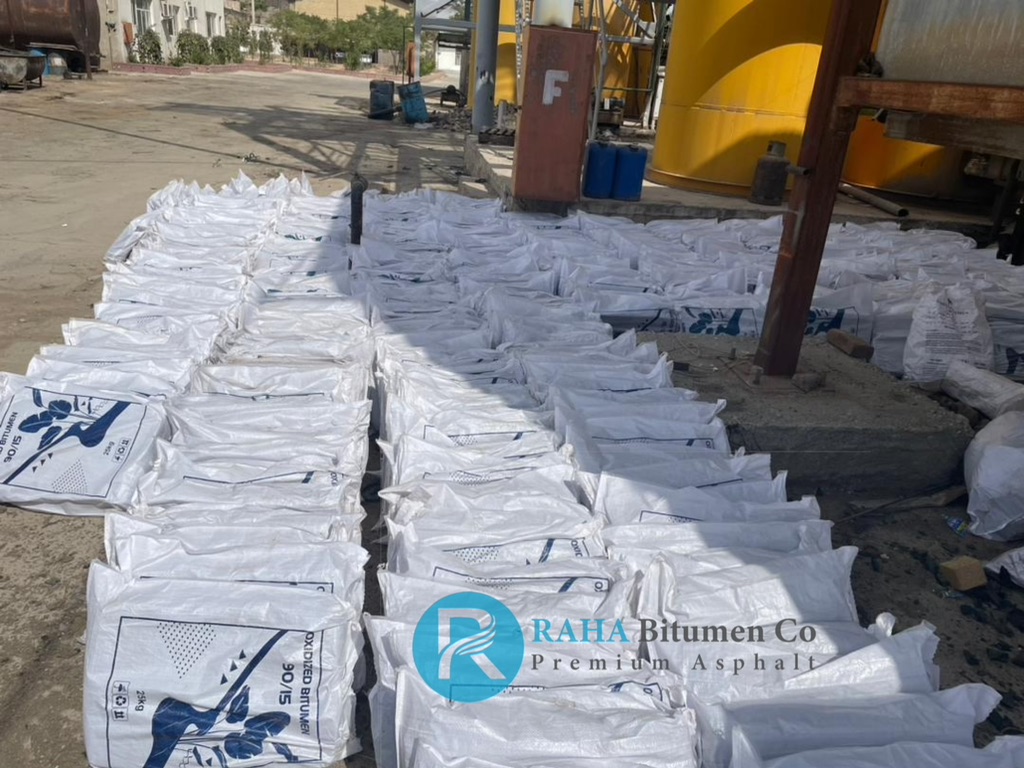
- Oxidized bitumen is received in 25kg meltable polyamide bags, kraft paper bags, or bulk tanker
- Material is loaded into heated mixing vessels and melted slowly to 160–180°C
- Temperature is carefully controlled to avoid overheating (maximum 230°C)
- Quality checks: softening point, penetration, and viscosity verified against specification
Step 2: Compounding (Formulation)
Pure oxidized bitumen is rarely used alone in sound dampening felt — it is compounded with other materials to optimize acoustic, mechanical, and processing properties:
Typical sound dampening felt formulation components:
- Oxidized bitumen (40–65%): Primary binder and damping agent — provides density, adhesion, and viscoelastic behavior
- Mineral fillers (20–40%): Calcium carbonate, barite (BaSO₄), or talc — increase density and mass, reduce cost, improve stiffness
- Fiber reinforcement (5–15%): Cellulose, glass fiber, or mineral wool — improve tensile strength, prevent cracking, aid processing
- Rubber modifier (0–10%): SBS or natural rubber — enhances flexibility at low temperatures, improves cold crack resistance
- Plasticizer (0–5%): Process oil — adjusts viscosity and flexibility during manufacturing
All ingredients are blended in heated mixers at 160–180°C until a homogeneous compound is achieved. Mixing time: typically 30–60 minutes with continuous mechanical agitation.
Step 3: Sheet Formation (Calendering or Extrusion)
The hot compound is formed into sheets using one of two methods:
Calendering (most common):
- Hot compound is fed between heated calendar rolls
- Rolls are set to the target thickness (typically 1.5mm to 6mm)
- Sheet emerges continuously and is immediately laminated with a release liner (polyethylene film) on one or both sides
- Typical production speed: 5–15 meters/minute
Extrusion:
- Compound is extruded through a flat die to produce sheets of precise thickness
- Used for thinner sheets (1.5–3mm) requiring tight thickness tolerances
Step 4: Lamination & Backing Application
Depending on the final product specification, different backing layers are laminated to the bitumen sheet:
- Aluminum foil backing: Provides additional mass, heat reflection, and aesthetic finish — common in premium automotive sound deadening
- Polyethylene film: Release liner for self-adhesive products
- Non-woven fabric: For products requiring a soft, non-tacky surface
- Fiberglass mat: Reinforcement for heavy-duty applications requiring high tear resistance
- Self-adhesive backing: Pressure-sensitive adhesive layer for easy installation without heating
Step 5: Cooling & Cutting
- Laminated sheet passes through cooling section (air or water-cooled rolls) to solidify
- Cut to required roll width or sheet dimensions on slitting and cutting lines
- Standard roll widths: 1,000mm–1,500mm
- Custom die-cut shapes available for automotive OEM supply
Step 6: Quality Control
Each production batch must be tested against specification:
- Thickness: Measured every 500mm across width (tolerance: ±0.2mm)
- Weight per m²: Critical for NVH performance — verified by sampling
- Softening point: Of the bitumen compound (Ring & Ball test, ASTM D36)
- Peel adhesion: Bond strength to steel substrate after oven activation
- Loss factor (η): Acoustic damping efficiency measured by Oberst beam test (ISO 6721-3)
- Cold crack test: Flexibility at -10°C or -20°C depending on specification
- Odor test: For automotive OEM products — VOC emissions compliance
Applications of Oxidized Bitumen Sound Dampening Felt
1. Automotive Floor Pans & Underbody
The largest single application for oxidized bitumen sound dampening felt. Pre-cut bitumen felt sheets are placed on the steel floor pan before the automobile body goes through the paint oven (typically 150–180°C). The heat activates the bitumen, causing it to soften and bond perfectly to the floor pan contours, creating a seamless, fully adhered damping layer.
Benefits:
- Reduces road noise, tire noise, and exhaust noise transmitted through the floor
- Reduces structural resonance of thin-gauge floor panels (0.6–0.8mm steel)
- Typical weight: 3–6 kg/m² — adds meaningful mass for sound blocking
- Applied area: 0.5–2.0 m² per vehicle depending on model and specification
Recommended grade: 85/25, 90/40
2. Automotive Door Panels
Door panels are a primary entry point for wind noise, traffic noise, and audio system vibration. Oxidized bitumen damping patches are applied to the inner door skin to control panel resonance and improve audio system performance.
Growing driver — Electric Vehicles (EVs): As EVs eliminate engine noise, other noise sources become more prominent. This has dramatically increased the specification of acoustic materials in EV door and body panels. The EV market is one of the strongest growth drivers for oxidized bitumen sound dampening felt manufacturers.
Recommended grade: 85/25, 90/40
3. Automotive Dash Panel & Firewall Insulation
The firewall/dash panel separates the engine compartment from the passenger cabin. Oxidized bitumen felt, often with an additional foam or fiber layer, is used on the cabin side of the firewall to block engine and exhaust noise.
Recommended grade: 90/40, 95/25
4. Automotive Trunk & Rear Panel
Trunk panels and rear shelf panels are prone to resonance from road and exhaust noise. Bitumen felt damping patches applied to these panels significantly reduce booming and droning in the rear passenger area.
Recommended grade: 85/25
5. Automotive Undercarriage Sealant Compound
A related application: oxidized bitumen is used as the base material for undercarriage sealant (underbody coating) — a thick, spray or trowel-applied compound that protects the vehicle underbody from stone chipping, corrosion, and road noise. This is closely related to sound dampening felt in both material composition and acoustic function.
Recommended grade: 85/25, 90/40
6. Building Acoustics – Floating Floor Systems
In construction, oxidized bitumen sound dampening felt is used under floating floor systems (parquet, laminate, tile) to reduce impact sound transmission between floors. A thin (3–5mm) bitumen felt layer under the floor covering absorbs footstep impact energy before it transmits to the structural slab below.
Typical specification:
- Thickness: 3–5mm
- Weight: 4–8 kg/m²
- Impact sound reduction: 15–25 dB (depending on system)
Recommended grade: 85/25
7. Machinery & Equipment Vibration Damping
Industrial machines, HVAC systems, compressors, and generators generate significant structure-borne vibration. Oxidized bitumen felt pads placed under equipment bases or bonded to equipment housings absorb vibration and reduce transmitted noise to surrounding structures.
Recommended grade: 90/40, 95/25
8. Dishwashers & Home Appliances
Pre-formed oxidized bitumen damping mats are bonded to the inner steel panels of dishwashers, washing machines, and refrigerators to reduce operational noise — a growing application in premium home appliance manufacturing.
Recommended grade: 85/25
Best Oxidized Bitumen Grades for Sound Dampening Felt
The choice of grade directly affects the damping efficiency, processing behavior, and temperature performance of the finished felt product.
| Grade | Softening Point | Penetration | Best Use in Sound Dampening |
|---|---|---|---|
| 85/25 | ~85°C | ~25 dmm | Most popular for automotive floor pan, door panel, building floor felt. Best balance of damping, flexibility, and processability |
| 90/40 | ~90°C | ~40 dmm | Flexible felt for cold-climate vehicles, applications requiring better low-temperature crack resistance |
| 95/25 | ~95°C | ~25 dmm | Hot-climate automotive applications, machinery damping, firewalls — higher heat resistance |
| 115/15 | ~115°C | ~15 dmm | High-temperature environments, engine bay adjacent applications, tropical climate production |
Most widely used grade for sound dampening felt globally: 85/25
Its softening point of ~85°C allows heat activation in automotive paint ovens (150–180°C) while providing excellent room-temperature stiffness and handling properties. For cold-climate vehicles, 90/40 offers improved flexibility at low temperatures.
Key Performance Properties – Oxidized Bitumen vs. Other Damping Materials
| Property | Oxidized Bitumen Felt | Rubber-Based | Butyl-Based | PU Foam |
|---|---|---|---|---|
| Material Cost | ⭐ Very Low | High | Medium-High | Medium |
| Density / Mass | ⭐ Very High | High | Medium | Low |
| Damping Efficiency | Good | ⭐ Excellent | ⭐ Excellent | Good (absorption) |
| Heat Activation | ⭐ Excellent | Limited | Good | N/A |
| Temperature Range | -10°C to +80°C | -30°C to +100°C | -20°C to +90°C | -30°C to +80°C |
| Automotive OEM Use | ⭐ Very Widespread | Widespread | Common | Common |
Conclusion: Oxidized bitumen sound dampening felt offers the best value for mass-produced automotive and construction applications — high density, reliable heat activation, proven OEM performance, and by far the lowest material cost. Rubber and butyl systems offer marginally better cold-temperature performance at significantly higher cost.
Technical Specifications – Standard Oxidized Bitumen Sound Dampening Felt
| Base Material | Oxidized bitumen + mineral fillers + fiber reinforcement |
| Standard Thickness | 1.5mm, 2mm, 3mm, 4mm, 5mm, 6mm (custom available) |
| Standard Weight | 2–12 kg/m² depending on thickness and formulation |
| Roll Width | 1,000mm – 1,500mm standard (custom widths available) |
| Activation Temperature | 130°C – 180°C (paint oven or heat gun) |
| Service Temperature Range | -10°C to +80°C |
| Damping Frequency Range | 100 – 5,000 Hz (most effective: 200–2,000 Hz) |
| Available Backings | PE film, aluminum foil, non-woven fabric, self-adhesive, plain |
| Test Standard | ISO 6721-3 (Oberst beam), ASTM E756 |
Why Oxidized Bitumen Sound Dampening Felt Demand Is Growing
1. Electric Vehicle Revolution
Electric vehicles produce no engine noise — which paradoxically makes them noisier inside. Without the masking effect of engine sound, road noise, wind noise, tire noise, and HVAC noise become highly noticeable. EV manufacturers are significantly increasing the specification of acoustic damping materials per vehicle. This is the single most powerful growth driver for oxidized bitumen sound dampening felt in the automotive sector.
2. Stricter NVH Regulations
Global vehicle noise regulations are tightening. Euro 6 and upcoming Euro 7 pass-by noise limits, combined with increasing consumer expectations for cabin quietness in mid-range and economy vehicles, are expanding sound dampening felt use beyond premium vehicles into mainstream models.
3. Construction Acoustic Regulations
Building codes in Europe (EN ISO 16283), North America, and Asia are increasingly mandating minimum acoustic performance levels for floors and walls in residential and commercial buildings. This is driving growing demand for oxidized bitumen felt in floating floor and wall systems.
4. Growth in Emerging Markets
Rising vehicle production in China, India, Southeast Asia, and Africa — combined with increasing consumer expectations for vehicle comfort — is expanding the market for automotive acoustic materials in markets where oxidized bitumen’s cost advantage is most compelling.
Why Source Oxidized Bitumen for Sound Dampening Felt from RAHA Bitumen?
RAHA Bitumen (RABIT) supplies oxidized bitumen to sound dampening felt manufacturers, automotive component suppliers, and acoustic material producers worldwide. Our sound dampening-grade materials offer:
- Tight softening point and penetration control — critical for consistent felt processing and activation behavior
- Low volatile content — reduced odor and VOC emissions, essential for automotive OEM supply chains
- Consistent batch-to-batch quality — SGS and Bureau Veritas third-party verified
- Full documentation: TDS, MSDS, COA for every shipment
- Multiple packaging options: 25kg meltable polyamide bags (most convenient for production), kraft bags, 200L drums, bulk
- Available grades for felt manufacturing: 85/25, 85/40, 90/40, 95/25, 115/15
- Fast global delivery from Isfahan, Iran via Dubai, UAE hub
📞 Contact our technical team:
Dubai Office: +971 56 281 7292 (WhatsApp)
Email: info@rahabitumen.com
Frequently Asked Questions
What grade of oxidized bitumen is used for sound dampening felt?
Oxidized bitumen 85/25 is the most widely used grade for sound dampening felt manufacturing. Its softening point of ~85°C allows perfect heat activation in automotive paint ovens (150–180°C) while maintaining dimensional stability at normal service temperatures. For cold-climate applications or products requiring greater low-temperature flexibility, 90/40 is preferred.
How does oxidized bitumen reduce sound and vibration?
Oxidized bitumen sound dampening felt works through constrained layer damping: when bonded to a vibrating surface (such as a car floor panel), the viscoelastic bitumen material converts mechanical vibration energy into heat through internal molecular friction. This reduces the amplitude of panel resonance and the noise it radiates into the interior. The high density of the bitumen felt (1,200–2,000 kg/m³) also provides significant sound blocking through the mass law.
What is the difference between sound dampening felt and sound absorption foam?
Sound dampening felt (bitumen-based) works by reducing panel vibration through added mass and viscoelastic damping — it prevents the panel from vibrating and radiating sound. Sound absorption foam works differently: it absorbs airborne sound waves, converting acoustic energy into heat within the foam structure. In practice, both are used together in automotive and building applications for comprehensive NVH control.
Can oxidized bitumen sound dampening felt be used in electric vehicles?
Yes — and demand is growing rapidly. Because EVs lack engine noise to mask other sounds, road noise, tire noise, and wind noise become more prominent. EV manufacturers are increasing their use of acoustic damping materials per vehicle, making oxidized bitumen felt a growing application in the EV sector.
What is the typical thickness for automotive sound dampening felt?
Standard automotive sound dampening felt is typically 1.5mm to 4mm thick for floor pan applications, with weight ranging from 2 to 8 kg/m². Heavier (4–6mm) material is used for premium vehicles and high-noise areas such as firewalls and dash panels. The optimal thickness is determined by the specific panel resonance frequencies and the NVH targets for the vehicle.
Is oxidized bitumen sound dampening felt suitable for building floors?
Yes. Oxidized bitumen felt (3–5mm thick) is widely used under floating floor systems (parquet, laminate, ceramic tile) in apartments and commercial buildings to reduce impact sound transmission between floors. It provides impact sound reduction of 15–25 dB depending on the system specification and is a cost-effective alternative to rubber-based underlays.
What is the activation temperature for bitumen sound dampening felt in automotive assembly?
Oxidized bitumen sound dampening felt activates (softens and bonds to the panel surface) at temperatures between 130°C and 180°C — temperatures typically reached in automotive paint cure ovens. The activation does not require any additional adhesive: the bitumen itself becomes the adhesive when heated, conforming to the panel shape and bonding permanently.
Summary – Oxidized Bitumen Sound Dampening Felt at a Glance
| Primary Applications | Automotive floor pans, doors, firewall, building floors, machinery |
| Top Grades | 85/25 (standard), 90/40 (flexible/cold climate), 95/25 (hot climate) |
| Standard Thickness | 1.5mm – 6mm |
| Activation Temperature | 130°C – 180°C |
| Service Temperature | -10°C to +80°C |
| Market Size (2025) | Automotive acoustics: USD 5.44 billion globally |
| Key Growth Driver | Electric vehicle production + stricter NVH regulations |
| Available From | RAHA Bitumen – Global Supplier |
Related Products & Pages:
→ Oxidized Bitumen 85/25 — standard sound dampening grade
→ Oxidized Bitumen 90/40 — flexible / cold-climate grade
→ Oxidized Bitumen 95/25 — high-temperature grade
→ Oxidized Bitumen for Roofing
→ Oxidized Bitumen for Waterproofing
→ Oxidized Bitumen for Pipe Coating
→ All Oxidized Bitumen Grades
Page last updated: May 2025 | Published by RAHA Bitumen Co. (RABIT) | Dubai, UAE & Isfahan, Iran
