Oxidized Bitumen for Waterproofing: Complete Guide, Best Grades & Applications
Oxidized bitumen — also known as blown bitumen or blown asphalt — is the world’s most widely used material for waterproofing in construction and infrastructure. From basement foundations and underground tunnels to bridge decks, retaining walls, and hydraulic structures, oxidized bitumen provides a proven, cost-effective, and long-lasting barrier against water infiltration.
The global waterproofing membrane market was valued at USD 29.47 billion in 2025 and is projected to reach USD 54.15 billion by 2033, growing at a 7.9% CAGR (Straits Research, 2025). Bituminous membranes — with oxidized bitumen as their core raw material — hold the largest market share of any waterproofing material type. In this expert guide, RAHA Bitumen’s technical team covers everything you need to know about using oxidized bitumen for waterproofing: the right grades, key applications, installation methods, and how to choose the best product for your project.
Why Oxidized Bitumen Is the Waterproofing Material
Waterproofing demands a material that can resist water pressure, maintain integrity across wide temperature ranges, adhere to complex surfaces, and last for decades without failure. Oxidized bitumen meets all of these requirements better than most alternatives — and at a competitive cost.
The air-blowing process that creates oxidized bitumen fundamentally transforms its molecular structure. Hot air reacts with the bitumen at 240°C–300°C, forming a denser, more cross-linked polymer network. The result is a material with:
- Near-zero water permeability: The dense gel-like structure is almost completely impermeable to liquid water and water vapor.
- High softening point (85°C–155°C): Prevents softening, flow, and membrane failure in hot climates or under direct sun exposure.
- Strong adhesion to substrates: Bonds firmly to concrete, masonry, metal, and fabric reinforcements — critical for below-grade waterproofing where adhesion must resist hydrostatic pressure.
- Chemical resistance: Resists acids, alkalis, salts, and soil chemicals that attack below-grade structures.
- Flexibility across temperatures: High Penetration Index (PI +2 to +8) ensures the material doesn’t crack in cold temperatures or flow in heat.
- Long service life: Properly installed oxidized bitumen waterproofing systems regularly last 25–40 years.
Key fact: Bituminous membrane held a 41.75% share of the below-grade waterproofing membranes market in 2025 — the largest of any material type (SNS Insider, 2025).
Waterproofing Applications of Oxidized Bitumen
1. Foundation & Below-Grade Waterproofing
One of the most critical waterproofing challenges in construction is protecting building foundations and below-grade structures from groundwater infiltration. Oxidized bitumen is applied as a continuous membrane on the exterior walls and base slabs of foundations, creating a seamless barrier that resists hydrostatic pressure from surrounding soil and groundwater.
Why oxidized bitumen works here:
- Resists constant hydrostatic pressure from groundwater
- Bonds to concrete and masonry substrates with high peel strength
- Chemically resistant to soil sulfates, chlorides, and organic acids
- Remains flexible enough to bridge minor structural cracks
The global basement bitumen waterproofing membrane market alone was estimated at USD 5.5 billion in 2025, growing at 6.2% CAGR through 2033 (Archive Market Research, 2025).
Recommended grades: 85/25, 95/25, 90/40
2. Waterproofing Membranes (Sheet Membranes)
Oxidized bitumen is the primary raw material in the manufacturing of waterproofing sheet membranes — the most widely used waterproofing product in construction worldwide. These membranes consist of a reinforcing carrier (polyester or fiberglass mat) coated on both sides with oxidized bitumen, sometimes modified with APP or SBS polymers for enhanced performance.
Types of bitumen waterproofing membranes that use oxidized bitumen:
- Torch-on membranes: Pre-manufactured rolls applied by heat fusion using a propane torch. The most common method globally for foundation, basement, and roof waterproofing.
- Self-adhesive membranes: Cold-applied with a peel-off backing. Used where open flame is not permitted — occupied buildings, near flammable materials.
- APP-modified membranes: Oxidized bitumen + Atactic Polypropylene polymer. Superior UV and heat resistance. Widely used in hot climates.
- SBS-modified membranes: Oxidized bitumen + Styrene-Butadiene-Styrene rubber. Excellent cold-temperature flexibility. Common in Europe and cold regions.
Recommended grades for membrane manufacturing: 115/15, 95/25, 85/25
3. Basement Wall & Floor Waterproofing
Basements are among the most vulnerable areas of any building to water damage. Oxidized bitumen is applied as a hot-poured or torch-on membrane system to basement walls and floor slabs, both on the positive side (exterior face) and negative side (interior face) depending on project requirements.
Application zones:
- Exterior basement walls (positive-side): most effective, applied before backfill
- Interior basement walls (negative-side): remedial waterproofing on existing structures
- Basement floor slabs: below-slab membrane installed before concrete pour
- Basement wall-floor joints: the most vulnerable leak point, requiring special detailing
Recommended grades: 85/25, 90/40
4. Underground Structure Waterproofing (Tunnels, Metro, Underpasses)
Underground infrastructure — metro stations, road tunnels, underpasses, utility tunnels — requires waterproofing systems that can withstand extreme hydrostatic pressure, ground movement, and decades of exposure. Oxidized bitumen sheet membranes and hot-applied systems are the standard specification for most underground infrastructure projects worldwide.
The below-grade waterproofing membranes market — covering tunnels, foundations, and underground structures — was valued at USD 3.78 billion in 2025 and is projected to reach USD 5.46 billion by 2035 (SNS Insider, 2025).
Recommended grades: 95/25, 115/15
5. Bridge Deck Waterproofing
Bridge decks are exposed to heavy traffic loads, freeze-thaw cycles, de-icing salt infiltration, and constant water exposure from rain and runoff. Oxidized bitumen membranes protect the structural concrete deck from chloride ion penetration and water damage — the primary cause of bridge deck deterioration.
Key requirements for bridge deck waterproofing:
- High resistance to shear from traffic loads above
- Excellent bond to concrete substrate
- Resistance to de-icing salts and chemical contamination
- Ability to withstand rapid temperature changes
Recommended grades: 95/25, 105/35, 115/15
6. Retaining Wall Waterproofing
Retaining walls hold back soil and must resist continuous groundwater pressure from behind. Oxidized bitumen membranes or hot-applied coatings are applied to the soil-facing side to prevent moisture penetration, efflorescence, and structural weakening of the wall.
Recommended grades: 85/25, 95/25
7. Hydraulic Structure Waterproofing (Dams, Reservoirs, Canals)
Oxidized bitumen has been used in hydraulic engineering for over a century. Its impermeability, chemical resistance, and ability to be applied as a thick, continuous barrier make it ideal for:
- Dam faces and cores
- Irrigation canal linings
- Reservoir linings and embankments
- Water treatment plant structures
Recommended grades: 90/40, 95/25
8. Parking Deck & Podium Slab Waterproofing
Parking structures and podium slabs are among the most waterproofing-intensive applications in construction. Constant vehicle traffic, water and oil exposure, and thermal cycling create challenging conditions. Oxidized bitumen membranes — particularly APP-modified systems — are the most common solution for multi-story parking decks.
The parking structures segment of the waterproofing membrane market is projected to reach USD 2.18 billion by 2035 (Market Research Future, 2025).
Recommended grades: 95/25, 115/15
9. Flat Roof Waterproofing
Flat and low-slope roofs are the primary waterproofing application for oxidized bitumen globally. Roofing accounts for 47.66% of total bitumen membrane demand in 2025 (Mordor Intelligence, 2025). For a complete guide to roof waterproofing with oxidized bitumen, see our dedicated page: Oxidized Bitumen for Roofing.
Best Oxidized Bitumen Grades for Waterproofing – Full Comparison Table
Selecting the correct grade is essential. The two numbers in each grade represent: softening point (°C) / penetration (dmm). Higher softening point = better heat resistance. Lower penetration = harder, more rigid material.
| Grade | Softening Point | Penetration | Best Waterproofing Use |
|---|---|---|---|
| 85/25 | ~85°C | ~25 dmm | Foundation waterproofing, basement walls, general below-grade membranes in temperate climates |
| 90/40 | ~90°C | ~40 dmm | Hydraulic structures, canal linings, below-grade applications needing flexibility |
| 95/25 | ~95°C | ~25 dmm | Bridge decks, tunnels, underground structures, hot-climate foundation waterproofing |
| 105/35 | ~105°C | ~35 dmm | Heavy-duty below-grade waterproofing, industrial structures, high-pressure environments |
| 115/15 | ~115°C | ~15 dmm | APP membrane manufacturing, hot-climate waterproofing, parking decks, tropical regions |
Quick Selection Guide:
- Basement / foundation (temperate): 85/25 or 90/40
- Basement / foundation (hot climate): 95/25 or 115/15
- Tunnel / underground structure: 95/25 or 105/35
- Bridge deck: 95/25 or 115/15
- APP membrane manufacturing: 115/15
- Hydraulic structures: 90/40 or 95/25
Oxidized Bitumen Waterproofing – Installation Methods
Method 1: Torch-On Application
The most widely used method for membrane waterproofing worldwide. Pre-manufactured oxidized bitumen membrane rolls are unrolled over the prepared substrate while a propane torch heats the underside, melting the bitumen and fusing the membrane to the surface. Overlapping seams (minimum 100mm) are also torch-fused to create a seamless system.
Best for: Foundations, basements, roof decks, bridge decks, tunnels
Key tip: Always apply a bitumen primer to the substrate first to improve adhesion.
Method 2: Hot-Poured Application
Oxidized bitumen is melted in a kettle to 220°C–230°C and poured or mopped directly over the surface as a liquid. It forms a continuous, seamless coating as it cools and solidifies. This method is used for both waterproofing layers and as an adhesive for multi-layer systems.
Best for: Flat roofs, hydraulic structures, canal linings, large horizontal surfaces
Important: Never overheat beyond 260°C — degradation occurs above this temperature.
Method 3: Cold / Self-Adhesive Application
Self-adhesive membranes use oxidized bitumen with a factory-applied adhesive backing. The protective film is peeled off and the membrane is pressed onto the substrate without heat. Increasingly popular for occupied buildings, cold climates, and fire-sensitive environments.
Best for: Interior basement waterproofing, occupied structures, cold-weather installation
Method 4: Bitumen Primer + Membrane System
For below-grade and foundation waterproofing, a bitumen primer (such as D-41) is applied first to seal the substrate and improve adhesion. Once the primer is tack-dry, the oxidized bitumen membrane system is applied on top. This two-component approach significantly increases bond strength and long-term performance.
Best for: Concrete foundations, basement walls, bridge abutments
→ See our Bitumen Primer D-41 product page for specifications.
Key Properties of Oxidized Bitumen for Waterproofing
1. Water Impermeability
The oxidation process creates a dense molecular network with extremely low porosity. Oxidized bitumen passes hydrostatic pressure tests at levels far exceeding those required for building foundations and underground structures.
2. Hydrostatic Pressure Resistance
Below-grade waterproofing must resist positive hydrostatic pressure from groundwater. Oxidized bitumen membranes, when properly detailed and bonded, withstand the hydrostatic pressures encountered in typical residential and commercial foundation depths (up to 10+ meters).
3. Chemical Resistance
Buried structures are exposed to aggressive soil chemistry: sulfates, chlorides, organic acids, and alkaline groundwater. Oxidized bitumen is chemically inert to these agents, making it the preferred choice for foundation and below-grade protection.
4. UV Stability (When Protected)
Oxidized bitumen is UV-sensitive if left exposed. In all below-grade applications this is irrelevant as the membrane is covered by soil, concrete, or protection board. For exposed applications (roofs, decks), it must be protected with mineral granules, aluminum foil, or a protective coating.
5. Crack-Bridging Ability
Minor structural movement and cracking is inevitable in buildings. Oxidized bitumen membranes have inherent flexibility that allows them to bridge hairline cracks (up to 1–2mm) without losing waterproofing integrity — a critical advantage over rigid waterproofing systems like cementitious coatings.
6. Compatibility with Reinforcement
Oxidized bitumen bonds excellently with polyester and fiberglass mat reinforcements, allowing the manufacture of composite membranes with both tensile strength and waterproofing performance — combining the best properties of both materials.
How to Choose the Right Oxidized Bitumen Waterproofing System
Step 1 – Define the application zone:
Underground/below-grade → 85/25 or 95/25 membrane system
Hydraulic structure → 90/40 or 95/25
Bridge or parking deck → 95/25 or 115/15
Roof waterproofing → see Roofing Guide
Step 2 – Assess hydrostatic pressure:
Low (surface drainage) → standard membrane system
Medium (shallow basement) → two-layer membrane system
High (deep basement, tunnel) → reinforced membrane + drainage board system
Step 3 – Consider climate:
Hot climate → higher softening point (95/25, 115/15)
Cold climate → higher penetration grade for flexibility (85/25, 90/40)
Wide temperature range → 95/25 (best balance)
Step 4 – Select installation method:
New construction exterior → torch-on or hot-poured
Occupied building / remedial → self-adhesive cold-applied
Large horizontal area → hot-poured
Step 5 – Confirm packaging for your project scale:
Membrane manufacturing → bulk or 200L drums
Direct application → 25kg meltable polyamide bags or cartons
Why Choose RAHA Bitumen for Waterproofing-Grade Oxidized Bitumen?
RAHA Bitumen (RABIT) supplies waterproofing-grade oxidized bitumen to membrane manufacturers, construction companies, and waterproofing contractors in over 100 countries. Our waterproofing-grade products offer:
- Pure air-blown production — no additives, fillers, or gilsonite blending
- Tight grade tolerances — consistent softening point and penetration batch to batch
- Full technical documentation — TDS, MSDS, COA for every shipment
- Third-party inspection — SGS and Bureau Veritas testing available
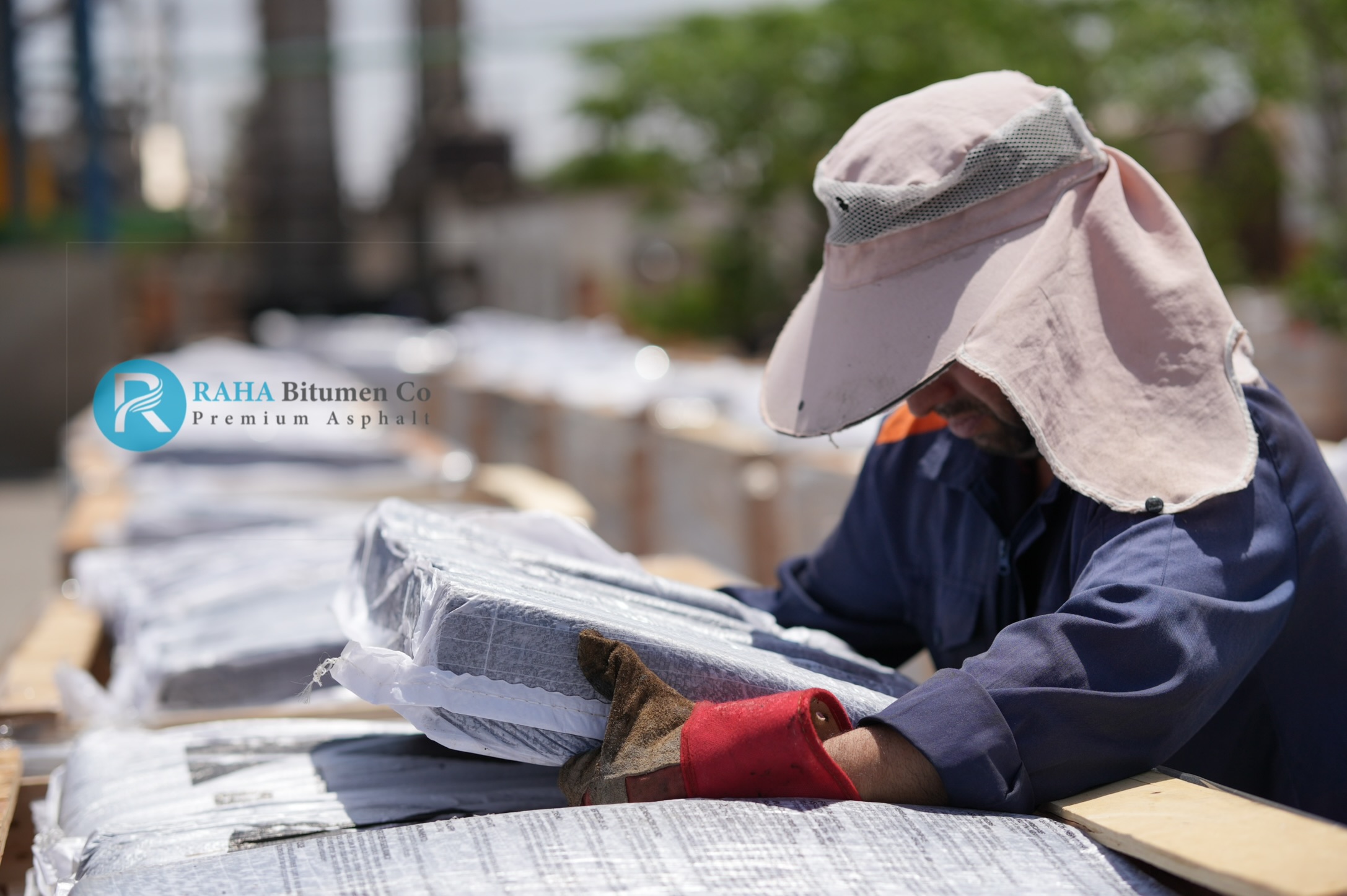
- Multiple packaging options: 25kg meltable polyamide bags, kraft bags, 200L steel drums, bulk tanker
- Fast global delivery from Isfahan, Iran via Dubai, UAE hub
- Available waterproofing grades: 75/25, 85/25, 85/40, 90/40, 95/25, 105/35, 115/15
📞 Contact our waterproofing specialists:
Dubai Office: +971 56 281 7292 (WhatsApp)
Email: info@rahabitumen.com
Frequently Asked Questions
What grade of oxidized bitumen is best for waterproofing foundations?
For foundation waterproofing in temperate climates, oxidized bitumen 85/25 or 90/40 is the standard choice, offering excellent adhesion and flexibility. In hot climates, 95/25 is preferred for its higher softening point. For high-hydrostatic-pressure environments such as deep basements or tunnels, 95/25 or 105/35 is recommended.
What is the difference between oxidized bitumen and bitumen primer for waterproofing?
Bitumen primer (such as D-41) is a thin, solvent-based liquid applied first to seal and prepare the substrate surface. Oxidized bitumen is the primary waterproofing material applied as a membrane or hot coating on top of the primed surface. Both are used together in a complete waterproofing system — the primer improves adhesion of the oxidized bitumen membrane to the substrate.
Can oxidized bitumen be used for below-grade waterproofing?
Yes, this is one of its primary applications. Oxidized bitumen sheet membranes and hot-applied coatings are extensively used for below-grade waterproofing of foundations, basements, tunnels, retaining walls, and underground structures. Its resistance to hydrostatic pressure and soil chemicals makes it ideal for below-grade use.
How many layers of oxidized bitumen membrane are needed for waterproofing?
For light applications (roof terraces, above-grade walls): one layer is often sufficient. For standard below-grade applications (residential basements): a minimum of two layers is recommended. For high-hydrostatic-pressure environments (tunnels, deep basements): two to three layers with reinforcement is standard practice.
What is the service life of oxidized bitumen waterproofing?
A well-designed and correctly installed oxidized bitumen waterproofing system typically has a service life of 25–40 years, depending on application type, installation quality, substrate condition, and environmental exposure. Below-grade systems generally outlast exposed roof systems due to protection from UV and thermal cycling.
Is oxidized bitumen waterproofing suitable for water tanks and reservoirs?
Yes, but with an important condition: the oxidized bitumen used must be confirmed as non-toxic and suitable for contact with potable water if the tank stores drinking water. For non-potable water storage (irrigation, industrial), standard grades (85/25, 90/40) are fully suitable. Always request a product-specific declaration of compliance from the supplier.
What is the difference between oxidized bitumen waterproofing membrane and modified bitumen membrane?
An oxidized bitumen membrane uses blown bitumen as its primary binder. A modified bitumen membrane adds APP or SBS polymer to the oxidized bitumen base, enhancing flexibility, elongation, and temperature performance. Modified membranes offer superior performance in extreme conditions but at higher cost. Oxidized bitumen (unmodified) remains the cost-effective standard for most below-grade waterproofing applications.
Summary – Oxidized Bitumen Waterproofing at a Glance
| Primary Applications | Foundations, basements, tunnels, bridge decks, hydraulic structures, membranes |
| Top Grades | 85/25, 90/40, 95/25, 115/15 |
| Installation Methods | Torch-on, hot-poured, self-adhesive, primer + membrane system |
| Expected Service Life | 25–40 years |
| Market Size (2025) | Bitumen membranes: USD 11.2 billion globally |
| Standards | ASTM D312, BS 3690, EN 13969 |
| Available From | RAHA Bitumen – Global Supplier |
Related Products & Pages:
→ Oxidized Bitumen 85/25 — most popular waterproofing grade
→ Oxidized Bitumen 95/25 — hot climate & underground structures
→ Oxidized Bitumen 115/15 — membrane manufacturing & APP systems
→ Oxidized Bitumen 90/40 — hydraulic & flexible applications
→ Bitumen Primer D-41 — for substrate preparation
→ Bitumen Roll Sheet & Membranes
→ Oxidized Bitumen for Roofing
→ All Oxidized Bitumen Grades
Page last updated: May 2025 | Published by RAHA Bitumen Co. (RABIT) | Dubai, UAE & Isfahan, Iran
