
Bitumen penetration grade 50/70
Definition of Bitumen Penetration Grade 50/70
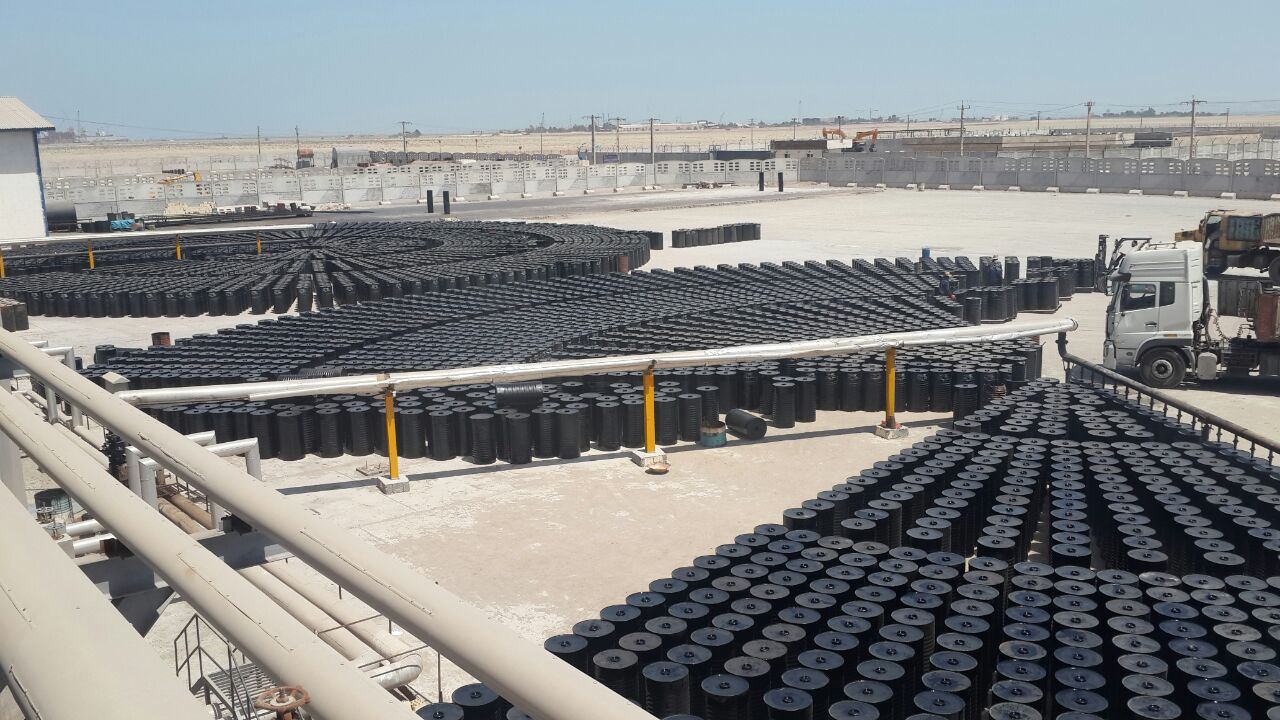
Bitumen Penetration Grade 50/70 From Turkey and UAE is a standard penetration grade Bitumen usually used as a Paving Grade Bitumen suitable for road construction and for the production of asphalt pavements with superior properties. This grade of Bitumen is mainly used in the manufacture of hot mix asphalt for bases and wearing courses. Penetration Grade Bitumensupplied by RABIT (RAHA BITUMEN) Co is petroleum grade bitumen, manufactured from fractional / vacuum distillation of crude oil. The Bitumen supplied by RABIT Co is produced from the vacuum residue (short residue) feedstock. Penetration Grade bitumens are specified by the penetration and softening point test. The designation is by penetration range only. The penetration grade bitumens have a thermoplastic property which causes the material to soften at high temperatures and to harden at lower temperatures. This unique temperature/ viscosity relationship is important when determining the performance parameters such as the adhesion, rheology, durability and application temperatures of bitumen.
Penetration Grade Bitumen is a standard bitumen usually used as a Paving Grade Bitumen essential for road construction and for the production of asphalt pavements with superior properties, and it’s very important once it bounds the aggregates and creates a unique cohesion and stability to the bituminous mix.
Application of Bitumen Grade 50/70
Bitumen 50/70 is suitable for road construction and for the asphalt pavements with superior properties. This type of bitumen used in the manufacture of hot mix asphalt for bases and wearing courses and the main usage of this product is used in the road at tropical regions.
Guaranty and safety of Bitumen Penetration 50/70
RABIT (RAHA BITUMEN) Company guaranty the quality of bitumen penetration grade 50/70 with the arrangement of the international inspectors to check quality and quantity of the bitumen penetration grade 50/70 during the loading to the vessel and controlling the production by QC by batch test report before shipping. RABIT Company guarantees the quality to meet with European Standard DIN EN 12591:99.
What is the Dencity of Bitumen 50/70
Density is a core physical characteristic that expresses how much mass is contained in a given volume of a material. For bitumen, this property is especially important because it influences how the material behaves and performs in different uses. Density is usually reported in kilograms per cubic metre (kg/m³) or grams per cubic centimetre (g/cm³). For the widely used penetration grade bitumen 50/70, the density typically falls between about 1,000 and 1,050 kg/m³.
That specific range matters because it affects how well the bitumen bonds to aggregate particles, how it resists deformation, and how it copes with varying environmental conditions. Bitumen with higher density often offers greater durability, stronger resistance to cracking and rutting, and improved waterproofing performance. Conversely, lower-density bitumen can be more vulnerable to damage and may not perform as well across temperature swings or over long service lives.
As an example, a density near 1,020 kg/m³ is considered a balanced target for bitumen 50/70, delivering an effective mix of flexibility and stiffness. This level allows the binder to adhere efficiently to aggregates, which is key to producing strong, long-lasting asphalt mixtures. In addition, bitumen around this density tends to better withstand oxidation, thermal cracking, and other forms of degradation over time.
Note: Typical technical data for bitumen 50/70 from suppliers cite a specific gravity range of about 1.01–1.06 at 25 °C, which corresponds to roughly 1,010–1,060 kg/m³, reinforcing the density range mentioned above.
Specification of Bitumen 50/70
| Bitumen 50/70 | Test method | Unit | Specification |
| Penetration @ 25°c | IP 49 | mm/10 | 50/70 |
| Softening point °c | IP 58 | °C | 46/54 |
| Kinematic Viscosity @ 135⁰C | IP 370 | mm2/s | 295 min |
| Flash point°c | IP 36 | °C | 230 min |
| Solubility is CS2(wt) % | IP 47 | wt % | 99 min |